

Best Private Jets for Business Executives in 2027
Estimated hourly charter rates for the executive aircraft featured in this 2027 guide range from approximately $3,400 for the Embraer Phenom 100 to $19,500 for a Boeing Business Jet.
Selecting the appropriate executive business jet depends on the specific travel requirements, including nonstop range, passenger and baggage capacity, and runway length at the airport nearest the destination. Aircraft manufacturer and cabin amenities become considerations once these operational requirements are satisfied.
The following comparison table outlines each aircraft's passenger capacity, range, cruise speed, and estimated hourly charter rate. A second table matches common corporate travel requirements with suitable aircraft categories.
You'll Learn
- Hourly charter rates for all 16 aircraft, presented side by side in one comparison table
- Why a faster jet with a higher hourly rate may cost less on a transcontinental flight
- How aircraft with similar hourly charter rates can differ significantly in payload capacity
- Which super-midsize jets may reach London nonstop and how prevailing winds affect return flights
- Where the Pilatus PC-24 can operate that other jets in this guide cannot
- How cabin pressure affects passenger comfort aboard long-range Global and Gulfstream aircraft
- When aircraft ownership may become more financially practical than chartering
How to Choose an Executive Business Jet
Five key performance factors determine which executive business jets are best suited for a particular trip, with nonstop range and allowances for prevailing winds among the most important considerations.
- Nonstop range, with allowances for wind. Published range figures are based on specified operating conditions and payload assumptions. Seven hours into an 80-knot headwind, a jet may cover approximately 560 fewer nautical miles over the ground. Adequate range margins are therefore essential when planning longer flights.
- Passenger and baggage capacity relative to fuel requirements. Full fuel tanks reduce the payload an aircraft can carry. With full fuel, a Phenom 300E carries 942 pounds, compared with 2,500 pounds for a Pilatus PC-24 at the same estimated $4,600 hourly charter rate. Maximum seating figures may also include a belted lavatory seat, making typical passenger capacity an important consideration.
- Cabin amenities designed for business productivity. Wi-Fi, conference tables, and individual power outlets depend on the configuration of the specific aircraft. Passengers should request an equipment list for the aircraft identified in their charter proposal.
- Runway requirements at departure and destination airports. Published takeoff distances assume specified operating conditions. High temperatures, airport elevation, and runway conditions can increase the distance required, with additional safety margins established by the charter operator.
- Hourly charter rates compared with total flight time. New York to Los Angeles covers approximately 2,140 nautical miles. Based on published cruise speeds and average hourly charter rates, the Citation X may offer a lower estimated flight cost than the Citation Latitude on certain transcontinental routes. Actual charter pricing depends on total billable flight time, aircraft positioning, and other operational factors.
Best Private Jets at a Glance
Each of the 16 aircraft in this guide is listed below with its recommended mission, passenger capacity, range, cruise speed, and estimated hourly charter rate. Figures are based on our aircraft listings and are organized from the lowest to the highest hourly rate.
Charter rates are averages and may vary based on season, aircraft positioning, fuel costs, and availability. Our guide to private jet rental costs explains the factors that influence a final charter quote.
The best executive jets for charter in 2027, by category and mission
Aircraft | Category | Best mission | Passengers (typical / max) | Range (nm) | Cruise speed (KTAS) | Hourly charter rate (USD) |
VLJ | Short regional flights for 2 to 4 people | 4 / 6 | 1,178 | 380 | ~$3,400 | |
Light | Regional airports and private strips | 6 / 7 | 1,776 | 404 | ~$3,750 | |
Super light | Trips of up to about 4 hours | 7 / 9 | 2,010 | 453 | ~$4,600 | |
Super light | Short and unpaved runways | 8 / 10 | 1,800 | 440 | ~$4,600 | |
Midsize | Golf trips and bulky equipment | 8 / 9 | 1,858 | 441 | ~$4,700 | |
Super midsize | Long legs from shorter runways | 8 / 9 | 3,200 | 446 | ~$6,200 | |
Super midsize | Transcontinental trips where speed counts | 8 / 9 | 2,890 | 525 | ~$6,200 | |
Midsize | Coast to coast in a stand-up cabin | 8 / 9 | 2,700 | 442 | ~$6,500 | |
Super midsize | Full cabin of 8 across the country | 8 / 10 | 3,500 | 453 | ~$7,000 | |
Super midsize | West Coast to Hawaii | 8 / 10 | 3,250 | 469 | ~$7,500 | |
Super midsize | Northeast to Europe on lighter loads | 8 / 10 | 3,400 | 469 | ~$7,500 | |
Ultra long range | Transpacific trips with a relief crew | 13 / 16 | 6,000 | 513 | ~$14,000 | |
Ultra long range | New York to the Middle East | 14 / 18 | 7,000 | 516 | ~$15,000 | |
Ultra long range | New York to Asia with four cabin zones | 14 / 17 | 7,700 | 516 | ~$17,000 | |
Ultra long range | Overnight flights to Australia | 13 / 19 | 7,750 | 516 | ~$17,000 | |
VIP airliner | Large teams flying intercontinental | 19 / 50 | 5,985 | 472 | ~$19,500 |
Light and Super-Light Jets for Regional Business Trips
Light and super-light jets offer some of the lowest hourly charter rates in this guide and are well suited for regional flights lasting up to approximately four hours, depending on passenger load and operating conditions.
Cabin height is a notable difference among these aircraft, measuring approximately 4.9 feet in both Phenom models compared with 5.7 feet in the Citation XLS+.
Phenom 100
The Embraer Phenom 100 typically seats four passengers and offers a laptop port at each seat, depending on aircraft configuration. With a published range of 1,178 nautical miles and a cruise speed of 380 knots, it is well suited for regional business travel, including routes such as New York to West Palm Beach, subject to operating conditions.
At an average of $3,400 per hour, it has the lowest estimated charter rate among the 16 aircraft compared in this guide.
Phenom 300E
The Phenom 300E is Embraer's updated version of the Phenom 300, featuring upgraded avionics and a redesigned cabin that typically accommodates seven passengers.
With a cruise speed of 453 knots, it can complete routes such as Chicago to Miami in approximately three hours, depending on winds and routing. Its published range of 2,010 nautical miles makes it a competitive option for longer regional flights.
The aircraft also offers an 84-cubic-foot baggage compartment, providing storage for luggage and business equipment. Its average hourly charter rate is approximately $4,600.
Citation XLS+
The Cessna Citation XLS+ offers a taller cabin than the Phenom 300E, although it has a shorter published range. Its typical configuration accommodates eight passengers.
Classified as a midsize jet, the Citation XLS+ has an average hourly charter rate of $4,700, approximately $100 more than the Phenom 300E.
With a published range of 1,858 nautical miles and a cruise speed of 441 knots, it is suitable for regional routes such as Boston to Orlando. Its 81-cubic-foot baggage compartment can accommodate golf equipment, luggage, and business materials.
Midsize and Super-Midsize Jets for Coast-to-Coast Executive Travel
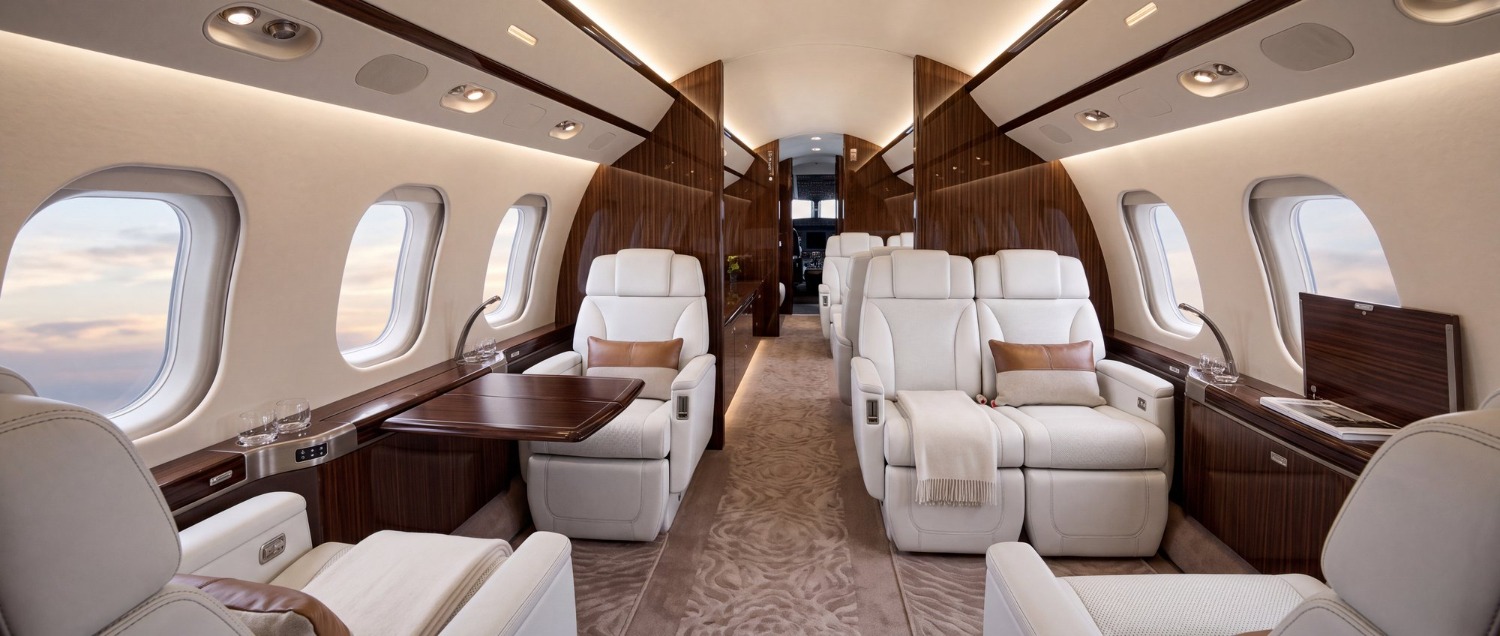
Midsize and super-midsize jets are commonly selected for transcontinental business travel, offering seating for approximately six to eight passengers and cabins approaching six feet in height.
Nonstop range, runway requirements, cabin configuration, and hourly charter rates are important considerations when selecting an aircraft within these categories.
Citation Latitude
Textron classifies the Citation Latitude as a midsize jet. It was the first Cessna business jet to feature a flat-floor stand-up cabin, offering approximately six feet of headroom and seating for eight passengers.
With a published range of 2,700 nautical miles and a cruise speed of 442 knots, the Latitude is suitable for many transcontinental routes. A flight from Miami to San Francisco, approximately 2,260 nautical miles, may be within its operating capabilities, depending on winds, payload, and required fuel reserves.
At approximately $6,500 per hour, the Latitude is a competitive midsize option for executives prioritizing cabin comfort. Its cabin altitude is designed to remain at approximately 6,000 feet when flying at 45,000 feet.
Challenger 350 and Challenger 3500
Bombardier's Challenger 350 and its successor, the Challenger 3500, typically accommodate eight passengers in a six-foot flat-floor cabin.
Both aircraft have published cruise speeds of 469 knots and average hourly charter rates of approximately $7,500. The Challenger 3500 offers a published range of 3,400 nautical miles, compared with 3,250 nautical miles for the Challenger 350.
Both aircraft may be suitable for flights between Los Angeles and Honolulu, a route of approximately 2,200 nautical miles. However, overwater operations require careful consideration of aircraft performance, fuel reserves, weather, and available diversion airports.
Certain super-midsize jets may complete select Northeast U.S. to London routes nonstop under favorable operating conditions. Actual capability depends on departure airport, passenger load, winds, fuel reserves, and aircraft performance.
Westbound return flights against prevailing winds may require a fuel stop at locations such as Gander, Newfoundland, or Keflavík, Iceland.
Citation Longitude
The Citation Longitude has the longest published range among the super-midsize aircraft featured in this guide, at 3,500 nautical miles, with a cruise speed of 453 knots.
Its double-club cabin typically accommodates eight passengers in two facing seating groups, providing separate areas suitable for business discussions during transcontinental flights.
With full fuel, the aircraft has a published payload capacity of 1,601 pounds, making passenger and baggage planning important for longer flights.
The average hourly charter rate is approximately $7,000.
Citation Sovereign+
Among the midsize and super-midsize jets in this guide, the Citation Sovereign+ offers comparatively short published takeoff distances.
Its listed takeoff distance of 3,530 feet is shorter than the Challenger 350's 4,836 feet, making it a practical option for certain regional airports with runway limitations.
With a published range of 3,200 nautical miles and a cruise speed of 446 knots, it can accommodate a typical passenger load of eight, subject to operating conditions.
Its average hourly charter rate of approximately $6,200 is $1,300 lower than that of the Challenger 350.
Performance Leaders: Speed and Short-Runway Access
The Citation X leads the aircraft in this guide in published cruise speed, while the Pilatus PC-24 and Citation Ultra offer access to certain airports with shorter runways.
These capabilities can be particularly valuable for executives traveling to regional business facilities, manufacturing sites, and destinations with limited airport infrastructure.
Citation X
Textron delivered the final Citation X+ in 2018, concluding production of the aircraft series. The Citation X remains available for charter and is recognized for its high-speed performance.
With a published cruise speed of 525 knots, it is the fastest aircraft listed in this comparison. Its range of 2,890 nautical miles makes it suitable for many transcontinental routes, depending on passenger load and operating conditions.
As the Citation X series is no longer in production, passengers should confirm the aircraft's refurbishment history and available cabin amenities, including Wi-Fi.
Its published takeoff distance of 5,480 feet may limit access to airports with shorter runways. Average charter rates are approximately $6,200 per hour.
Citation Ultra
The Citation Ultra offers access to smaller regional airports, with published takeoff and landing distances of 3,180 feet and 2,290 feet, respectively.
Compared with the Phenom 100, it typically accommodates two additional passengers and offers approximately 600 nautical miles of additional range.
With a published range of 1,776 nautical miles and a cruise speed of 404 knots, it is well suited for same-day corporate site visits requiring access to smaller regional airports.
Its average hourly charter rate is approximately $3,750.
Pilatus PC-24
The Pilatus PC-24 is designed for operational flexibility, including the ability to use certain unpaved runways under approved conditions.
Its capabilities include operations on qualifying gravel, grass, and other runway surfaces, subject to aircraft certification, airport conditions, and operator approval. The aircraft also meets the requirements for steep-approach operations at London City Airport.
With a published takeoff distance of 2,930 feet, the PC-24 offers the shortest listed takeoff distance among the jets featured in this guide.
Typical missions may include travel to remote facilities, ranches, and industrial sites where runway infrastructure is limited.
The PC-24 typically accommodates eight passengers, with a maximum seating capacity of ten. It has a published range of 1,800 nautical miles and a cruise speed of 440 knots.
Average charter rates are approximately $4,600 per hour. Passengers requesting flights to unpaved airports should provide runway details so the charter operator can confirm operational suitability.
Large and Ultra-Long-Range Jets for Transatlantic and Global Trips
The Global 6000, Gulfstream G650, Global 7500, and Gulfstream G700 are designed for extended international travel and can accommodate approximately a dozen or more passengers, depending on cabin configuration.
On flights lasting ten hours or longer, cabin pressure, seating arrangements, and onboard amenities become important considerations.
These aircraft are designed to maintain relatively low cabin altitudes during high-altitude flight, contributing to a more comfortable cabin environment on extended international journeys.
Global 6000
Bombardier's Global 6000, the successor to the Global Express XRS, offers a published range of 6,000 nautical miles and a cruise speed of 513 knots.
With typical seating for 13 passengers and a published cabin altitude of approximately 4,500 feet, it is designed for long-distance international travel.
Dedicated crew rest accommodations support extended flight operations with additional flight crew, subject to applicable regulations and operator procedures.
The Global 6000 is suitable for demanding international routes, including certain transpacific flights, depending on operating conditions.
At approximately $14,000 per hour, it has the lowest average charter rate among the four ultra-long-range business jets compared in this section.
Gulfstream G650
The Gulfstream G650 typically accommodates 14 passengers and offers a published range of 7,000 nautical miles with a cruise speed of 516 knots.
Its long-range capabilities make it suitable for international routes such as New York to Dubai, approximately 5,950 nautical miles, subject to winds, passenger load, and fuel requirements.
The aircraft maintains a cabin altitude of approximately 3,000 feet at a cruising altitude of 41,000 feet, contributing to passenger comfort during extended flights.
Lavatories at both ends of the cabin provide additional convenience for larger groups traveling internationally.
Average charter rates are approximately $15,000 per hour.
Global 7500
The Global 7500 features four separate living spaces within its approximately 54-foot cabin, allowing passengers to conduct meetings in one cabin zone while others rest in a separate area.
The aircraft typically accommodates 14 passengers, with a maximum capacity of 17, depending on configuration.
With a published range of 7,700 nautical miles and a cruise speed of 516 knots, the Global 7500 is designed for demanding intercontinental missions.
Routes such as New York to Hong Kong require careful assessment of actual routing, winds, passenger load, and fuel reserves to determine nonstop feasibility.
The average hourly charter rate is approximately $17,000.
Gulfstream G700
The Gulfstream G700 offers up to five living zones, including configurations with a private master suite, fixed bed, and stand-up shower.
The aircraft typically accommodates 13 passengers, with a maximum seating capacity of 19, depending on configuration.
With a published range of 7,750 nautical miles and a cruise speed of 516 knots, the G700 is designed for extended international flights.
Its published cabin altitude of approximately 2,840 feet contributes to passenger comfort during long-duration travel.
Demanding routes, including flights between North America and Australia, require mission-specific performance planning to determine whether nonstop service is possible.
Average charter rates are approximately $17,000 per hour, comparable to the Global 7500.
Bombardier's Global 8000, with a published maximum speed of Mach 0.95, represents another significant development in high-speed business aviation.
Business Jets for Executives: Matching the Aircraft to Corporate Missions
Selecting business jets for executives begins with identifying the company's travel requirements.
A same-day regional business trip, a multi-city investor roadshow, and an international board meeting may each require a different aircraft category.
For organizations developing corporate travel policies, the most suitable aircraft are those that consistently meet their most common mission requirements.
The following table matches five typical corporate travel scenarios with appropriate aircraft categories.
Mission | Typical route | Suitable aircraft |
Same-day shuttle between offices | New York to Chicago and back | Light or super-light (Phenom 300E, Citation XLS+) |
Investor roadshow, several cities in 2 to 3 days | Boston, New York, Chicago and San Francisco | Midsize or super-midsize (Citation Latitude, Challenger 3500) |
Visit to a plant or site with a short runway | Regional field near a factory, ranch, or mine | Pilatus PC-24 or Citation Ultra |
Board meeting in Europe | New York to London or Paris | Super-midsize eastbound or large (Challenger 3500, Global 6000, G650) |
Team of 10+ to another continent | Los Angeles to Tokyo, New York to Dubai | Ultra long range or Boeing Business Jet |
The Boeing Business Jet provides an option when passenger requirements exceed the capacity of traditional ultra-long-range business jets.
Depending on configuration, it may accommodate approximately 19 passengers in a typical layout and as many as 50.
With a published range of 5,985 nautical miles and an average hourly charter rate of $19,500, it is designed for large-group international travel.
Its approximately 7.1-foot cabin height and available configurations may include private bedrooms, offices, and showers.
Integrated boarding stairs can also provide flexibility at airports with limited ground-handling infrastructure.
Charter, Jet Card Membership, or Aircraft Ownership?
An owned aircraft may be well suited to a company's primary travel requirements but offer less flexibility for other mission profiles.
Companies with varying travel requirements may benefit from Paramount Business Jets' Jet Card Membership program, which provides access to different aircraft categories based on each trip's operational needs.
Alternatively, on-demand corporate charter allows organizations to arrange flights as needed without the capital investment and ongoing operational responsibilities associated with aircraft ownership.
Our report on companies and CEOs with private jets examines the aircraft used by major corporations and business leaders.
Why Use a Broker for Your Next Mission?
Working with a private jet charter broker provides access to aircraft operated by multiple charter operators through a single point of contact.
As a charter broker operating under the U.S. Department of Transportation's Part 295 regulations, Paramount Business Jets does not own or operate aircraft. Instead, we source charter options from a worldwide network of more than 4,000 available aircraft.
This network allows us to evaluate aircraft performance, runway requirements, seasonal weather conditions, and cabin configurations before recommending an appropriate aircraft for each executive travel mission.
Every operator included in a charter proposal must first satisfy our screening requirements. Paramount Business Jets declines 73% of certified operators, and ARGUS Gold is the minimum standard for U.S. flights.
Before departure, clients receive an ARGUS TripCHEQ, WYVERN PASS, or in-house safety report, with oversight from a dedicated Safety Manager.
Additional information about our operator screening procedures and safety requirements is available on our safety standards page.
Frequently Asked Questions
What is the best private jet for executives who fly coast to coast?
For transcontinental business travel, passenger capacity, cabin comfort, and sufficient nonstop range are important considerations.
Westbound winter flights from New York to Los Angeles may encounter strong headwinds, making adequate fuel reserves and range margins particularly important.
Among the aircraft featured in this guide, the Challenger 3500 offers a published range of 3,400 nautical miles, compared with 2,890 nautical miles for the Citation X and 2,700 nautical miles for the Citation Latitude.
The Challenger 3500 may provide greater operational flexibility for nonstop transcontinental flights with a full passenger cabin, although actual performance depends on winds, payload, and flight planning requirements.
Which business jets can fly nonstop from New York to London?
Ultra-long-range aircraft such as the Global 6000, Gulfstream G650, Global 7500, and Gulfstream G700 are generally well suited for nonstop flights between New York and London.
Certain super-midsize jets may also complete eastbound transatlantic flights under favorable operating conditions.
However, westbound flights can encounter stronger headwinds, potentially requiring a fuel stop.
Aircraft selection should account for route distance, passenger load, weather, and required fuel reserves rather than published range alone.
What is the fastest business jet in service today?
The Bombardier Global 8000 has a published maximum speed of Mach 0.95, exceeding the Gulfstream G700's published maximum speed of Mach 0.935.
Among the 16 aircraft compared in this guide, the Citation X has the highest listed cruise speed at 525 knots.
Actual flight times depend on cruise speed, routing, prevailing winds, and operational restrictions.
Which private jets can land on short runways?
Several aircraft in this guide offer comparatively short published landing distances.
The Phenom 300E has a listed landing distance of approximately 2,220 feet, followed by the Citation Ultra at 2,290 feet, Pilatus PC-24 at 2,375 feet, and Phenom 100 at 2,701 feet.
However, runway suitability depends on more than published landing distance.
Airport elevation, temperature, runway conditions, aircraft weight, and operator safety requirements must all be considered.
Airports at higher elevations, such as Aspen or Telluride, may require additional performance planning and payload restrictions.
Is it better for a company to charter or own an executive jet?
The decision depends on annual flight hours, travel frequency, aircraft requirements, capital availability, and operating costs.
On-demand charter is often suitable for organizations with limited or variable annual flight requirements.
Jet Card Membership programs may offer additional convenience for companies that fly regularly but do not require a dedicated aircraft.
Aircraft ownership may become financially practical for organizations with substantial and consistent annual utilization, although the break-even point varies considerably by aircraft type and operating structure.
For example, a new Global 7500 has an estimated acquisition price near $75 million. However, comparing its purchase price directly with charter rates does not account for crew salaries, maintenance, insurance, hangar expenses, depreciation, and other ownership costs.
Our own vs. charter jet guide provides additional information about aircraft ownership, fractional shares, leasing, and on-demand charter.
Updated 11/06/26