

The World's Most Challenging Airports for Private Jets: What Every Charter Passenger Should Know
When people think of challenging airports, famous names like St. Barts, Aspen, and London City often come to mind. What many private jet travelers don't realize is that the most difficult airport isn't always the one with the shortest runway or the steepest approach.
In private aviation, a challenging airport can mean many things.
It may require specially trained pilots. It may have runway length limitations, mountain terrain, strict operating procedures, limited weather reporting, restricted operating hours, fuel availability issues, or even security requirements that make planning far more complex than passengers ever see.
Fortunately, those complexities are handled behind the scenes by experienced charter professionals.
The best private jet flights feel effortless because someone has already solved every operational challenge before you arrive at the airport.
At Paramount Business Jets, we've spent more than two decades coordinating private jet flights into thousands of airports worldwide. One lesson stands out time and again:
The closest airport isn't always the best airport.
In many cases, choosing an airport just 20 or 30 minutes farther away can dramatically improve aircraft availability, reduce costs, minimize weather-related delays, and provide a smoother overall experience.
This guide explains some of the world's most challenging airports for private jets, why they require additional planning, and what experienced charter advisors consider long before your aircraft is dispatched. The operational insights shared throughout this article are based on real-world charter planning discussions and practical experience coordinating flights into demanding destinations.
Quick Answer
Several airports consistently rank among the most challenging for private jet operations due to a combination of terrain, weather, runway limitations, operational restrictions, and infrastructure.
Some of the most demanding include:
- London City Airport (United Kingdom)
- Aspen (Colorado)
- Telluride (Colorado)
- St. Barts (Caribbean)
- Ronald Reagan Washington National Airport (Virginia)
- Olbia Costa Smeralda (Italy)
- Madeira Airport (Portugal)
- Naples Municipal Airport (Florida)
- Jackson Hole (Wyoming)
The challenges extend far beyond difficult landings. Aircraft performance, airport slots, pilot qualifications, fueling capabilities, weather reporting, pavement strength, and overnight parking all influence whether a particular aircraft can safely operate into an airport.
Why Some Airports Are More Challenging Than Others
Passengers often assume every airport can accommodate every private jet.
In reality, every airport has its own operational characteristics.
Experienced charter advisors evaluate dozens of factors before recommending an airport, including:
- Runway length
- Usable runway after displaced thresholds
- Runway width
- Aircraft performance requirements
- Airport elevation
- Terrain surrounding the airport
- Weather reporting capabilities
- Air traffic restrictions
- Slot availability
- Noise restrictions
- Fuel availability
- FBO operating hours
- Ground handling capabilities
- Overnight aircraft parking
- Security requirements
- Pavement strength
- De-icing availability
- Customs and immigration procedures
Many of these considerations are invisible to passengers but have a direct impact on which aircraft can safely complete a mission.
A Smaller Airport Isn't Always Better
One of the biggest misconceptions in private aviation is that choosing the airport closest to your destination automatically produces the best experience.
That's often not the case.
Smaller airports may offer shorter drive times, but can introduce challenges such as:
- Limited runway length
- No jet fuel
- Over-the-wing fueling instead of single-point fueling
- No overnight parking
- No full-service FBO
- Limited catering
- Limited rental cars
- No weather reporting equipment
- No air traffic control tower
- Limited aircraft maintenance support
In some cases, selecting a larger airport just a short drive away results in greater aircraft availability, lower charter costs, fewer operational restrictions, and significantly more flexibility if weather changes.
As many experienced charter professionals will tell you:
Saving twenty minutes on the ground isn't always worth adding hours of operational complexity in the air.
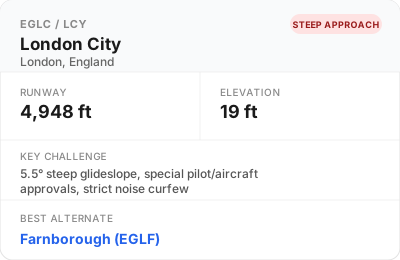
1. London City Airport (EGLC), England
Why It's Challenging
London City is widely considered one of Europe's most demanding airports for business aviation.
Unlike most commercial airports, London City requires special aircraft approvals and pilot qualifications due to its steep approach procedures and operational limitations.
Only approved aircraft types and specially qualified crews may operate there.
In addition to pilot certification requirements, operators must also contend with:
- Strict slot controls
- Noise restrictions
- Dense European airspace
- Limited operating hours
- High demand during business travel periods
What Clients Should Expect
Not every aircraft can legally or operationally fly into London City.
Depending on your itinerary, another London-area airport may offer:
- Greater aircraft availability
- Lower operating costs
- More scheduling flexibility
An experienced charter advisor will evaluate your destination, passenger schedule, and aircraft requirements before recommending whether London City is truly the best option.
2. Aspen/Pitkin County Airport (ASE), Colorado
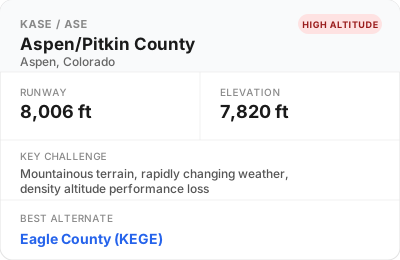
Aspen remains one of North America's most sought-after private jet destinations—and one of its most operationally demanding.
High elevation, mountainous terrain, rapidly changing weather, and aircraft performance limitations all combine to create an airport that requires careful planning.
Unlike airports at sea level, aircraft operating into Aspen experience reduced performance due to the altitude and thinner air.
Winter conditions add another layer of complexity.
Snowfall, mountain winds, reduced visibility, and rapidly changing weather patterns can alter flight plans with little notice.
What Clients Should Know
Even when conditions appear favorable at departure, weather can change before arrival.
Experienced charter advisors routinely prepare alternate airports before departure.
Common alternatives include:
- Eagle (EGE)
- Rifle (RIL)
Having contingency plans already in place often prevents unnecessary delays if conditions deteriorate.
3. Telluride Regional Airport (TEX), Colorado
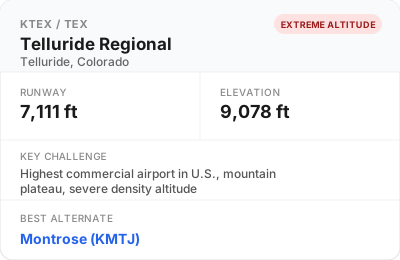
At more than 9,000 feet above sea level, Telluride is the highest commercial airport in North America.
Its location atop a mountain plateau creates unique operating challenges unlike almost anywhere else.
Common considerations include:
- High elevation
- Mountain terrain
- Strong winds
- Rapid weather changes
- Aircraft performance limitations
Even experienced operators may occasionally recommend nearby alternatives depending on conditions.
Client Tip
Weather—not distance—is often the deciding factor.
If operational conditions change, nearby Montrose Regional Airport (MTJ) is frequently the preferred option, with a drive of approximately 1 hour to Telluride.
That additional drive may ultimately provide a more reliable travel experience than attempting multiple approaches into Telluride itself.
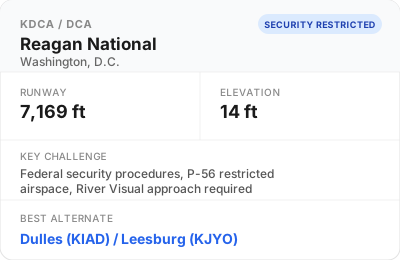
4. Ronald Reagan Washington National Airport (DCA)
Unlike most airports on this list, Reagan National isn't difficult to navigate because of its terrain.
It's challenging because of security.
Private jet operations into DCA require additional federal security procedures that do not apply at most airports.
Depending on the operation, flights may require:
- Special security coordination
- Approved operators
- Additional passenger screening
- Enhanced scheduling requirements
These procedures can also increase costs and reduce aircraft availability.
Client Tip
If your destination is downtown Washington, D.C., Reagan National may be worthwhile.
However, depending on your schedule, nearby airports such as Washington Dulles (IAD) or Leesburg Executive Airport (JYO) may offer greater flexibility and a wider selection of aircraft while still providing convenient access to the nation's capital.
Why Experience Matters More Than Ever
A recurring theme in real-world charter operations is that successful trips are built on preparation—not luck.
Experienced charter advisors don't simply request quotes. They ask the operational questions that prevent problems before they happen.
Before presenting aircraft options, they evaluate issues such as:
- Can the aircraft safely use the available runway?
- Are there weather-related operating limitations?
- Is fuel available on-site?
- Can the aircraft remain overnight?
- Are there after-hours FBO fees?
- Is the airport staffed?
- Is there reliable weather reporting?
- Are alternate airports already identified if conditions change?
Addressing these questions early helps eliminate surprises and gives passengers confidence that every aspect of the trip has been considered well before departure.
5. Madeira Airport (FNC), Portugal
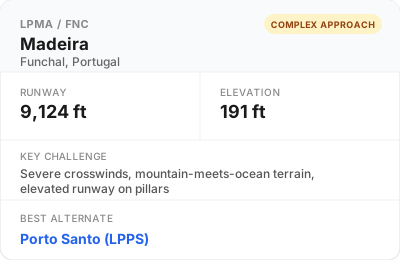
Madeira Airport is regularly ranked among the world's most challenging airports, and for good reason.
Located on Portugal's Atlantic Island of Madeira, the airport is surrounded by mountainous terrain on one side and the ocean on the other. Strong crosswinds, rapidly changing weather, and complex approach procedures require exceptional planning.
Unlike many airports where aircraft simply follow a straight-in approach, arrivals into Madeira often require pilots to make precise maneuvers while accounting for changing wind conditions.
Not every aircraft—or every flight crew—is approved to operate there.
Why It Matters to Private Jet Travelers
Madeira's weather can change quickly, particularly during winter and transitional seasons.
Passengers should understand that safety always comes before schedule. Even highly experienced crews may delay or divert if conditions exceed safe operating limits.
Experienced charter advisors monitor these conditions before departure and continue monitoring throughout the flight, helping reduce last-minute surprises whenever possible.
6. Olbia Costa Smeralda Airport (OLB), Italy
Olbia serves Italy's famous Costa Smeralda (Emerald Coast), one of Europe's premier luxury destinations.
During the summer, demand for private jet arrivals increases dramatically as travelers head to Sardinia's resorts and superyacht marinas.
While Olbia's runway itself presents few technical challenges, operational restrictions make it one of Europe's more demanding airports.
These include:
- Heavy seasonal traffic
- Limited airport slots
- Parking restrictions
- High demand for handling services
- Aircraft repositioning requirements
During peak holiday periods, planning several weeks in advance is often advisable.
Client Tip
If you're traveling during July or August, securing aircraft availability early is just as important as booking accommodations.
Aircraft parking may be limited, so your aircraft may need to be repositioned to another airport and returned later for your departure.
Understanding those logistics before your trip helps avoid unexpected costs or scheduling surprises.

7. St. Barts (Gustaf III Airport)
Few airports are as instantly recognizable as St. Barts.
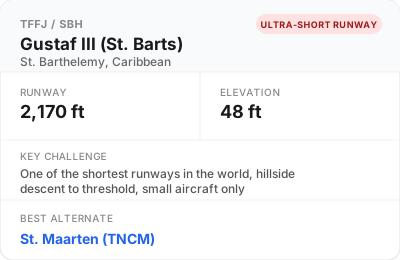
Its dramatic hillside approach and famously short runway have made it one of the most photographed airports in the world.
The airport's runway is approximately 2,100 feet long, making it unsuitable for most business jets.
Only specially approved aircraft and qualified flight crews may operate there.
Many larger private jets instead fly passengers into nearby St. Maarten before completing the final leg via smaller aircraft or helicopter.
Why Clients Should Know
Choosing the right aircraft from the beginning is essential.
Attempting to use an aircraft that cannot legally or safely operate into St. Barts simply creates unnecessary complications.
An experienced charter advisor will determine the most efficient routing based on:
- Passenger count
- Luggage
- Aircraft performance
- Weather
- Schedule
Sometimes the most seamless journey involves combining multiple transportation options rather than forcing a single aircraft to complete the entire trip.
8. Naples Municipal Airport (APF), Florida
Naples is one of Florida's busiest business aviation airports, particularly during the winter season.
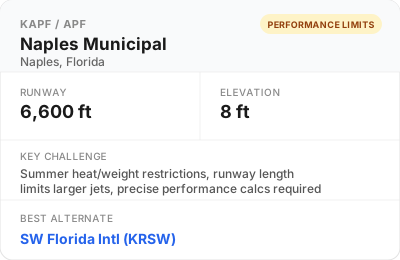
Although its runway length appears sufficient for many aircraft, operators frequently evaluate additional factors before accepting flights.
Runway conditions, aircraft weight, temperature, and performance calculations all influence whether a particular aircraft can safely operate.
Operational decisions often become even more conservative following rainfall or during adverse weather.
Why This Matters
Many passengers assume every midsize or super-midsize jet can simply land wherever a runway exists.
In reality, operators evaluate far more than published runway length.
Aircraft weight, landing performance, weather, runway conditions, and safety margins all influence the final decision.
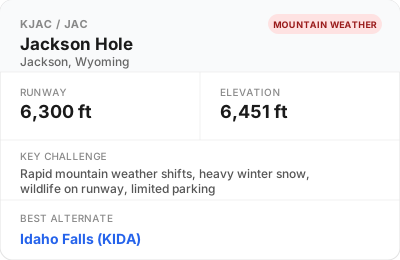
9. Jackson Hole Airport (JAC), Wyoming
Jackson Hole offers spectacular access to Grand Teton and Yellowstone National Parks.
It also presents unique operational challenges.
The airport experiences:
- Mountain weather
- High elevation
- Heavy winter snowfall
- Wildlife activity
- Strong seasonal demand
During ski season, aircraft parking becomes extremely limited.
In some cases, aircraft may need to reposition after dropping passengers before returning to the departure gate.
Client Tip
Booking early during peak ski season significantly improves aircraft availability and scheduling flexibility.
Waiting until the last minute may reduce aircraft options and increase repositioning costs.
10. Smaller Regional Airports: Sometimes the Greatest Challenge
Interestingly, many of the most operationally challenging airports aren't internationally famous.
They're small regional airports.
These airports often bring together several limitations at once:
- Short runways
- Narrow taxiways
- Limited pavement strength
- No jet fuel
- Limited operating hours
- Self-service fueling
- No overnight security
- No air traffic control tower
- Limited weather reporting
- No catering
- Limited ground transportation
On paper, these airports appear perfectly suitable.
Operationally, however, they may restrict which aircraft can safely use them.
This is one reason experienced charter advisors spend significant time evaluating destination airports—not just aircraft.
Understanding Short Runways: It's More Than Just the Published Length
One of the most misunderstood concepts in private aviation is runway length.
Passengers often hear that an airport has a 5,000-foot runway and assume every business jet can use it.
Unfortunately, aviation isn't that simple.
Several additional factors determine the actual amount of runway available.
These include:
- Displaced thresholds
- Runway slope
- Elevation
- Temperature
- Surface conditions
- Aircraft weight
- Obstacles surrounding the airport
A runway advertised as 5,000 feet may actually provide considerably less usable landing distance once these factors are taken into account.
Professional flight departments calculate these performance margins before every trip.
They never rely solely on the published runway length.
Pavement Strength Matters Too
Runway length isn't the only limitation.
The pavement must also be able to support an aircraft's weight.
Every airport publishes pavement classifications that determine which aircraft may safely operate there.
Some smaller airports have adequate runway length but insufficient pavement strength for larger business jets.
In those cases, operators may recommend a different aircraft—or an entirely different airport—to protect both safety and airport infrastructure.
This is another detail most passengers never see, but one that experienced charter professionals routinely evaluate before confirming a flight.
One Lesson We've Learned After Coordinating Thousands of Private Jet Flights
Perhaps the biggest takeaway isn't about any individual airport.
It's about preparation.
The smoothest private jet trips aren't necessarily the easiest ones.
They're the ones where potential challenges have already been identified, discussed, and planned for long before the aircraft arrives.
Whether the concern is weather, runway performance, fueling, security, parking, or alternate airports, experienced planning allows passengers to enjoy the journey while aviation professionals quietly manage the complexities behind the scenes.
Quick Comparison: 20 Challenging Airports for Private Jets
Airport | Primary Challenge | Best Client Advice |
London City | Special pilot and aircraft approvals | Book early and confirm aircraft eligibility |
Aspen | Mountains and weather | Always identify an alternate airport |
Telluride | High elevation and terrain | Be prepared for weather-related diversions |
Ronald Reagan Washington National | Security restrictions | Plan additional lead time |
Madeira | Crosswinds and mountainous terrain | Expect the weather to influence operations |
Olbia | Summer congestion and slots | Reserve well in advance |
St. Barts | Extremely short runway | Choose the correct aircraft from the outset |
Naples | Performance limitations | Aircraft selection matters |
Jackson Hole | Winter weather and parking | Book early during ski season |
Mountain weather | Often serves as an Aspen alternative | |
Weather backup | Valuable alternate destination | |
Summer congestion | Slot planning is essential | |
Mykonos | Peak-season traffic | Expect limited parking |
Courchevel | Altiport and steep approach | Suitable only for specially approved aircraft |
Congestion | Flexible scheduling helps | |
Butler, Georgia | Limited services | Plan fueling and repositioning |
Garrett County, Maryland | Fueling limitations | Verify aircraft compatibility |
Santa Rosa, New Mexico | Pavement strength | Review airport suitability before booking |
Smaller Remote Airports | Limited infrastructure | Evaluate services before selecting an airport |
Self-Service Airports | Limited ground support | Confirm operational capabilities early |
Weather Can Change Everything
One of the biggest misconceptions about private aviation is that weather affects every airport equally.
It doesn't.
Mountain airports, coastal airports, and airports with limited weather reporting often require much more conservative operational decisions.
An airport that is fully operational in the morning may become temporarily unavailable later that afternoon due to changing winds, visibility, thunderstorms, or low cloud ceilings.
Experienced charter professionals monitor weather continuously—not just before departure, but throughout the flight—to anticipate changing conditions and adjust plans when necessary.
The goal isn't simply to complete the trip.
The goal is to complete it safely.
Why Alternate Airports Are Part of Every Good Flight Plan
One of the strongest operational lessons from years of coordinating private jet flights is simple:
Always have a Plan B.
The best charter advisors begin discussing alternate airports before they're ever needed.
If weather deteriorates, a runway closes unexpectedly, or airport conditions change, having a preplanned alternative allows the flight to continue with minimal disruption.
For many mountain destinations, an alternate airport may add only 30 to 60 minutes of driving while avoiding hours of delays or multiple unsuccessful approaches.
Passengers rarely notice this planning because it happens behind the scenes.
That's exactly how it should be.
What Experienced Charter Advisors Evaluate Before Recommending an Airport
Selecting an airport involves much more than finding the closest runway.
Before recommending an airport, experienced charter advisors evaluate questions such as:
- Is the runway long enough for the selected aircraft?
- How much usable runway remains after displaced thresholds?
- Is the pavement rated for this aircraft?
- Is Jet A fuel available?
- Is overnight parking permitted?
- Does the airport have a full-service FBO?
- Are after-hours fees applicable?
- Will the weather likely affect the operation?
- Are special permits required?
- Are specially qualified pilots needed?
- Are there slot restrictions?
- Is there reliable weather reporting?
- What alternate airports should be planned?
These operational details often determine whether a trip proceeds smoothly or encounters avoidable complications.
Frequently Asked Questions
What is the most challenging airport for private jets?
There isn't a single answer. Airports such as London City, Aspen, St. Barts, Madeira, and Courchevel each present different operational challenges, including runway limitations, mountainous terrain, weather, security requirements, or special pilot certifications.
Can every private jet land at every airport?
No.
Aircraft size, performance, weight, runway length, pavement strength, pilot qualifications, and airport restrictions all determine whether a specific aircraft can safely operate into a particular airport.
Why can't larger private jets use certain airports?
Some airports have runways that are too short, narrow, steep, or unable to support the aircraft's weight. Others have operational restrictions or terrain that limit which aircraft are approved to operate there.
Do difficult airports make flying less safe?
No.
Private aviation is built around risk management.
When airport conditions exceed established safety margins, operators delay, divert, or recommend alternate airports rather than attempt unsafe operations.
Professional flight crews are trained to operate within strict performance and safety requirements.
Why does my charter advisor recommend a different airport than the closest one?
Because convenience isn't measured only by driving distance.
A nearby airport may have operational limitations that increase costs, reduce aircraft availability, or create unnecessary delays.
Sometimes choosing an airport 20 to 30 minutes farther away results in a faster, smoother, and more reliable travel experience overall.
Final Thoughts
The world's most challenging private jet airports aren't defined by a single factor.
Some require specially qualified pilots.
Others demand precise aircraft performance calculations.
Many are affected by mountain weather, short runways, congestion, security restrictions, or limited airport infrastructure.
What they all have in common is the need for thoughtful planning.
The best private jet experience begins long before passengers arrive at the airport. It starts with selecting the right aircraft, choosing the most suitable airport, evaluating weather and operational conditions, and preparing practical alternatives if plans change.
At Paramount Business Jets, we believe that exceptional service means identifying potential challenges before they become problems. From evaluating airport suitability and aircraft performance to monitoring weather, coordinating FBO services, and planning alternate airports, every detail is reviewed with one objective in mind: delivering a safe, seamless, and stress-free travel experience.
Whether you're flying to Aspen for ski season, St. Barts for a Caribbean getaway, London City for business, or a remote regional airport with unique operational considerations, working with an experienced private jet charter advisor helps ensure your journey is planned with the same level of care as the flight itself.Paramount Business Jets