

Private Aviation Trends and Industry Statistics in 2026

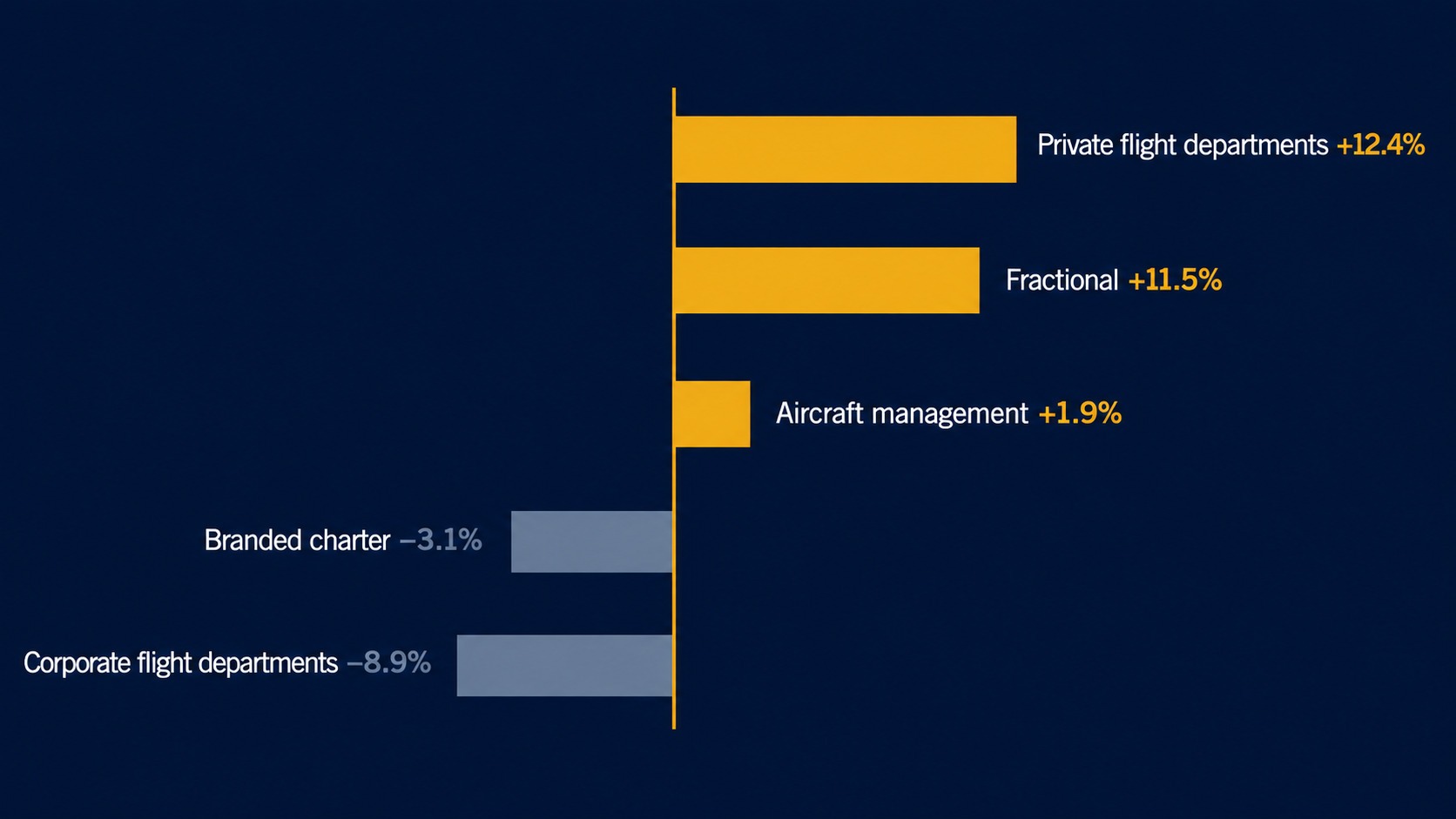
Business jet departures reached 1.95 million worldwide in the first half of 2026, up 4% year over year and running about 35% above pre-pandemic 2019. The composition matters more than the total. Fractional programs grew departures 11.5% over the same period, while branded charter contracted 3.1% and corporate flight departments fell 8.9%.
Growth is real. It’s also narrow, and the limit it’s running into is crew and hangar space. In late July, NetJets stopped selling new jet cards and short leases for the second time in five years, citing demand it can’t take on without degrading service to the owners it already has.
If you’re booking this year, the live question has moved from what it costs to whether the aircraft is there.
Private Jet Industry Statistics for the First Half of 2026
Global business jet activity rose 4% in the first half of 2026. WINGX counted 1.95 million departures worldwide, of which North America accounted for 1,403,700, close to 72% of all flights and up 5% year over year. Every region grew except the Middle East, which fell 17.8%.
Regional Departures and Growth Rates
Region | H1 2026 change vs H1 2025 |
|---|---|
North America | +5.0% |
Latin America | +4.6% |
Europe | Close to flat |
Middle East | −17.8% |
Europe recorded 270,800 departures, 13.9% of the global total, making it the second-largest market in the private aviation industry by a wide margin.
Middle East Activity and Airspace Restrictions
The 17.8% drop reflects the operating environment after the US-Israel-Iran conflict rather than any loss of appetite for private flying. Airspace closures, insurance conditions and route availability shut down flights clients still wanted. When we quote a trip, whether it’s permitted and whether it’s practical are separate questions, and regional activity figures collapse them into one number.
Event demand distorts short-run readings too. WINGX analysts flagged the 2026 World Cup months ahead as a source of extra traffic for operators and FBOs across three host countries.
Fractional Operators Absorbed Nearly All 2026 Growth
Those 1.95 million departures split unevenly across operator types.
Departures by Operator Type
Operator type | H1 2026 departures | Share of global | Change vs H1 2025 |
|---|---|---|---|
Aircraft management | 423,300 | 21.7% | +1.9% |
Fractional | 396,600 | 20.3% | +11.5% |
Private flight departments | — | — | +12.4% |
Branded charter | — | — | −3.1% |
Corporate flight departments | — | — | −8.9% |
Two segments carry the entire increase. Fractional programs added 11.5%. Private flight departments, meaning aircraft flown for a single owner, added 12.4% as new ultra-high-net-worth owners set up their own operations.
Everything else is flat or shrinking. Aircraft management, still the largest category, grew under 2%. Branded charter, which covers most jet card programs, lost 3.1%.
Corporate flight departments dropped 8.9%, pointing to fleet rationalisation rather than less corporate travel. Some of it has probably shifted into fractional shares rather than disappeared.
Two operators explain most of the movement. NetJets flew 266,500 flights in the first half of 2026 — 13.6% of every business jet departure worldwide. Flexjet flew 97,500, another 5.0%. Their departure growth ran 11.8% and 11.0% respectively.
Large-Cabin Demand as the Exception
ARGUS recorded large-cabin activity down 3.3% in June 2026, with Part 91 large-cabin flying off 7.1%. Travis Kuhn, the firm’s senior vice president of software, sees “erosion of demand in the large cabin market” continuing, per ARGUS’s June activity report.
NetJets Jet Card Suspension and Private Jet Capacity Limits
In late July 2026, NetJets stopped selling its 25-hour jet cards and 25-hour leases and restricted its 50-hour lease product. Existing contracts are being honoured and renewals continue, unlike 2021, when the company halted renewals as well and pushed a wave of customers into the market looking for alternatives.
The stated reason wasn’t weak demand:
record-high retention rates, alongside increased Owner and market demand
That comes from the company’s own explanation of the pause, which framed the decision as protecting service for existing card, lease and share owners.
Crew and Hangar Space as the Binding Constraint
NetJets isn’t shrinking. It expects delivery of roughly 80 new jets during 2026, and its fleet passed 845 aircraft in March, up from 781 a year earlier. A company adding aircraft at that rate still ran out of room to sell.
Three constraints set the pace:
Qualified crew. Training a captain onto a type takes months, and hiring budgets don’t compress the requirement.
Hangar and ramp space. Capacity at the airports you want is finite and slow to expand.
Maintenance slots. MRO capacity ranks among the headwinds IADA’s dealer members flag most consistently.
 \
\
Capacity Allocation by Tier in Fleet Programs
Any single-fleet program allocates aircraft by tier when supply gets short:
Fractional share owners
Lease holders
Jet card holders
NetJets published the hierarchy in its own product terms. Its fractional programs carried 10 peak days a year. Its 25-hour leases carried 90 restricted days.
The squeeze reaches the lower tiers first, and it usually shows up as blackout dates, longer booking windows and peak-day surcharges rather than as an announcement.
Pre-Owned Business Jet Inventory Near a Decade Low
Pre-owned business jet inventory sits well below its ten-year norm. At the end of June 2026, 6.5% of the active jet fleet was listed for sale, against a ten-year average of 8.1%. Transactions rose over the same period, so the pool of available aircraft is shrinking while more buyers compete for it.
Why Pre-Owned Transaction Figures Disagree Across Sources
Two trackers reported the first half of 2026 differently. AMSTAT put pre-owned business jet transactions up 7% year to date. IADA reported 746 closed transactions, up 21%.
Both are right. They count different populations.
AMSTAT tracks the whole market. IADA tracks its own accredited members, roughly 7% of the world's aircraft dealers, who handle about 40% of global pre-owned volume. A 21% rise among accredited dealers alongside 7% market growth means volume is consolidating toward accredited firms, not that the market grew 21%.
Inventory percentages diverge for a similar reason. Some counts cover jets only, others fold in turboprops, and snapshot dates differ by weeks. JETNET puts for-sale inventory at 6.7% of the installed fleet so far in 2026, against 7.3% last year and the 9 to 12% range that held through 2014 to 2020. Different denominator, same direction.
The listings that remain skew old. Aircraft 16 years and older make up 74% of for-sale inventory, while those under five years old account for 5%. That gap explains how asking prices can soften across categories while the aircraft buyers want gets harder to buy.
Why Business Jet Market Size Estimates Diverge by Threefold
Three research houses published 2026 business jet market values within months of each other: Straits Research at $27.3 billion, Fortune Business Insights at $50.6 billion, Grand View Research at $83.4 billion. Same market, same year, threefold spread.
Each draws the boundary somewhere different (new aircraft revenue, charter services, aftermarket), and none publishes its methodology outside the paywall. A figure that moves by 3x depending on who counted it won't tell you whether you can get a jet next Tuesday.
The global installed business jet fleet is a firmer number. JETNET counted roughly 25,500 aircraft as of May 2026, growing at a 3.4% compound annual rate since 2001.
Tax Policy and Backlogs Behind the Inventory Squeeze
US bonus depreciation returned in the July 2025 tax law, letting some owners write off the full cost of a business aircraft in the first year. That pulled purchase decisions forward. OEM backlogs, which JETNET put near $53 billion at the end of Q1 2025, mean new delivery slots run years out. Buyers who won't wait move to the used market, and IADA's dealers describe the resulting scramble for low-hour, well-maintained airframes as the defining feature of the year.
Heavy jets show it most sharply. Transactions rose 18.5% in the first half of 2026, and nearly two-thirds of IADA respondents expect further price increases in the large-jet segment.
Large-cabin flying declined this year while large-jet resale demand rose. Utilisation and ownership demand move independently.
UK Air Passenger Duty Changes for Private Jets in 2026 and 2027
The UK raised the higher rate of Air Passenger Duty by 50% on 1 April 2026. That rate applies to aircraft of 20 tonnes and above carrying fewer than 19 passengers. From 1 April 2027 it extends to every aircraft of 5.7 tonnes or more operating as a private or business jet.
Band (distance from London) | Higher rate from 1 April 2026 |
Domestic | £142 |
Band A (0–2,000 miles) | £142 |
Band B (2,001–5,500 miles) | £1,097 |
Band C (over 5,500 miles) | £1,141 |
APD is charged per passenger on departure from a UK airport. The operator pays it and passes it through, so it lands in your charter quote whether or not anyone itemises it. Ask for it itemised.
Midsize Jets Enter the Higher Rate From April 2027
HMRC published the extension of the higher rate on 13 July 2026. The current 20-tonne threshold leaves most midsize jets paying the standard rate. The 5.7-tonne threshold catches nearly all of them.
The same measure amends section 31 of the Finance Act 1994 so the child passenger exemption stops applying to business jets. From April 2027, a family flying private out of the UK pays full higher-rate duty on every seat, including the children's.
HMRC scores the extension at roughly £10 million a year. It's a small revenue measure with a large per-passenger effect on a narrow group of flights.
Fuel and Emissions Costs in Private Aviation
Fuel runs on a different clock from tax. We cover SAF mandates, emissions schemes and the aircraft built to meet them in our guide to sustainable aviation milestones for 2026.
FAA Aircraft Ownership Privacy Rules and Current Status
Since March 2025, private aircraft owners have been able to ask the FAA to withhold their name and address from public display. The request goes through the CARES system as a signed PDF, one aircraft at a time, and it's opt-in.
Whether withholding becomes the default is unresolved. The FAA requested comment on that question in April 2025 and extended the comment period a month later. No final determination has been published.
NBAA was still making its case to the agency in February 2026. The statutory deadline under 49 U.S.C. § 44114(b) passed on 16 May 2026.
An earlier version of this article treated the 2024 legislation as though the protection already existed in full. It didn't then and it doesn't now. The mechanism is live. The default is still open.
If you charter rather than own, none of this reaches you directly, because you never appear on a registry. It matters when you're weighing ownership against access.
New Business Jet Deliveries and Fleet Capacity Through 2035

Manufacturers shipped 854 business jets in 2025, up 11.8% on 2024 and the strongest output since 2009. GAMA put total aircraft billings at $35.7 billion, a 14.6% increase and the highest in the report's history. Honeywell expects 2026 deliveries about 5% above 2025.
Where those aircraft land matters more than how many arrive. Fractional fleets have grown more than 65% since 2019 to roughly 1,300 jets, and 80% of those are light, midsize or super-midsize. That's the segment absorbing new capacity, and it explains why availability tightened there first.
Charter operators are ordering too. Among Part 135 and equivalent operators, 28% told Honeywell they hold at least one aircraft on firm order, against 20% of operators overall.
Private Aviation Market Trends for 2026 and the Supply Timeline
Honeywell forecasts 8,500 new business jets worth $283 billion over the next decade, averaging 3% annual growth. Read against the current squeeze, that's a real supply response arriving late.
An aircraft ordered today lands years out. The crew to fly it qualifies on a similar clock, and hangar space at the airports people use expands slower than either. Relief arrives on a multi-year timeline, which does nothing for a trip you're booking now.
Private Jet Industry Trends 2026 and Charter Planning
Book earlier than you did last year. Fractional and card programs are rationing access, and the crew and hangar limits behind that apply across the industry. Availability moves before price does. Start early enough to see real options rather than whatever's left on the date.
Cabin class changes the picture. Light and midsize supply is tightest, because that's where fractional growth concentrated. Large-cabin availability is comparatively better than it was a year ago, so if the mission justifies the aircraft, the market is working in your favour there.
UK departures need pricing separately from April 2026 and rethinking from April 2027. Aircraft weight now drives a per-passenger tax that runs past £1,000 on long-haul routes.
Vetting carries more weight when the pool is wider. A single-fleet program handles the safety work behind the scenes. Sourcing on demand means somebody has to check each operator's ARGUS, Wyvern or TripCHEQ standing against the specific aircraft and crew assigned to your trip. That's what our safety process covers, and it's a fair question to put to anyone quoting you.
Checking Private Jet Availability for a Specific Trip
Tell us the trip and we'll tell you what can fly it.
We broker rather than operate, which means we source across the whole market instead of one fleet. In a year when capacity is the binding constraint, that's the difference between a shortlist and a single answer.
Request a charter quote or call +1-877-727-2538
Frequently Asked Questions
Is Booking a Private Jet Harder in 2026 Than in 2025?
For light and midsize aircraft, yes, particularly on peak dates and at short notice. Fractional absorption landed hardest in exactly those cabin classes. Large-cabin aircraft are easier to source than a year ago. The difference usually shows up as longer lead time rather than an outright no.
How Far in Advance Should a Private Jet Be Booked in 2026?
No universal number holds, and anyone quoting one is guessing. What's changed is the window for getting your first-choice aircraft, which has widened for light and midsize jets on peak dates. Short-notice trips still fly. The aircraft is just less often the one you wanted.
How Do Charter, Jet Cards and Fractional Ownership Differ?
Charter buys a single trip on an operator's aircraft with no ongoing commitment. A jet card prepays hours at a fixed rate against a program fleet, with contract terms governing access. Fractional ownership buys a share in a specific aircraft plus a management agreement. Cost predictability rises across that order, and so does the commitment.
Does a Jet Card Guarantee Aircraft Availability?
A jet card guarantees access on contract terms, not an aircraft on any given date. Fleet programs allocate capacity by tier, and card holders sit below fractional owners. The published peak-day and blackout schedules show where any given product sits in that order. Read them before the hourly rate.
Most-Flown Private Jet Types in Charter and Fractional Service
Super-midsize jets recorded more US charter and fractional departures than any other cabin class in 2025, roughly 463,000, up 8% year over year. Embraer's Phenom 300 has been the world's best-selling light jet for fourteen consecutive years, which is why it turns up across so many program fleets.
Are Private Jet Charter Prices Rising in 2026?
Charter pricing faces upward pressure from three directions: tighter aircraft availability, higher crew costs, and in the UK, a materially larger tax component. Rates vary too much by aircraft, route and date for any headline figure to help you. What has changed is that the cheapest option and the available option are less often the same aircraft.
Taxes and Fees on US Private Jet Charter Flights
Domestic US charter carries a 7.5% federal excise tax on the amount paid, plus a segment fee of $5.30 per passenger per segment for 2026. That excise tax generally replaces state sales tax on the flight itself. International segments swap in head taxes and foreign duties instead.
Do UK Air Passenger Duty Changes Apply to Flights Arriving in the UK?
No. A flight from New York into London carries no UK duty at all. The return leg does, banded by the distance from London to the destination country's capital city rather than by flight time.