

Booking a private flight puts two very different companies in front of you, and only one of them is legally responsible for getting you there safely. The operator holds the certificate and flies the aircraft. The broker arranges the trip, shops the market, and answers to you. Knowing where the comparison between a private jet operator and a broker actually changes your risk separates an informed booking from a hopeful one.
We'll say up front what plenty of brokers bury in a footer. Paramount Business Jets arranges flights as the client's agent, and we don't own or operate a single aircraft. Working with no fleet of our own is the whole point of the model, since it frees us to shop the entire market on your behalf and check an operator's work with no stake in the outcome.
You'll learn
Why the company you book through doesn't set your safety floor, and the one thing a broker actually changes
How to tell a real Part 135 operator from an illegal "gray charter" in about two minutes
The single question that reveals more than any safety pitch, before you pay a deposit
The contract red flags that map straight to the DOT's own disclosure rules
What a good broker demands of every operator on your behalf, most of it out of your sight
Private Jet Broker vs Operator: What's the Difference?
An aircraft operator holds an FAA Part 135 certificate, maintains and crews the jets, and keeps operational control of every flight it runs. An air charter broker works as a bona fide agent under DOT Part 295, sourcing aircraft, vetting operators, negotiating price, and coordinating the trip. The operator flies you. The broker never does.
| Air Charter Broker | Aircraft Operator | |
|---|---|---|
What it is | Bona fide agent, indirect air carrier | Direct air carrier |
Governed by | DOT, 14 CFR Part 295 | FAA, 14 CFR Parts 119 |
Certificate to fly you | None, does not operate aircraft | Part 135 Operating Certificate |
Owns or maintains the aircraft | No | Yes |
Operational control of the flight | No | Yes |
Who's in the cockpit | The operator's crew | The operator's crew |
Role on your trip | Sources, vets, negotiates, coordinates | Crews, maintains, flies |
Paid for | Sourcing and oversight, | The flight itself |
The one line in that table doing real legal work is operational control. Whoever holds it answers for the conduct of the flight, from airworthiness to crew duty time to the go or no-go call in bad weather, and that party is always the certificated operator. In regulatory language, the operator is the direct air carrier, the certificated air carrier actually authorized to fly passengers for hire, and a broker sits a step removed, coordinating everything around your trip without ever holding that control.
Our founder helped the Department of Transportation write Part 295 during his tenure as president of the Air Charter Association of North America, so the rule that governs brokers is one we know from the drafting table. It set the transparency and disclosure standards every US charter broker now works under, and that's part of why we hold to its consumer protections to the letter.
How Brokers Source Aircraft From Third-Party Operators
A broker owns no jets, so every aircraft it offers comes from a certificated operator somewhere in the market. When a request lands with us, we go out to the Part 135 operators whose aircraft and positioning fit the mission, then put them in competition on price and terms. The carrier that ends up flying you is always the actual operator, the one holding the certificate and the aircraft. We earn our keep by finding the best-vetted, best-positioned jet for the trip across our worldwide operator network, since we have no fleet of our own to push.
Reaching across the whole market only helps if every candidate clears the same bar.
Operator vs Broker: The Safety Standards You Should Expect
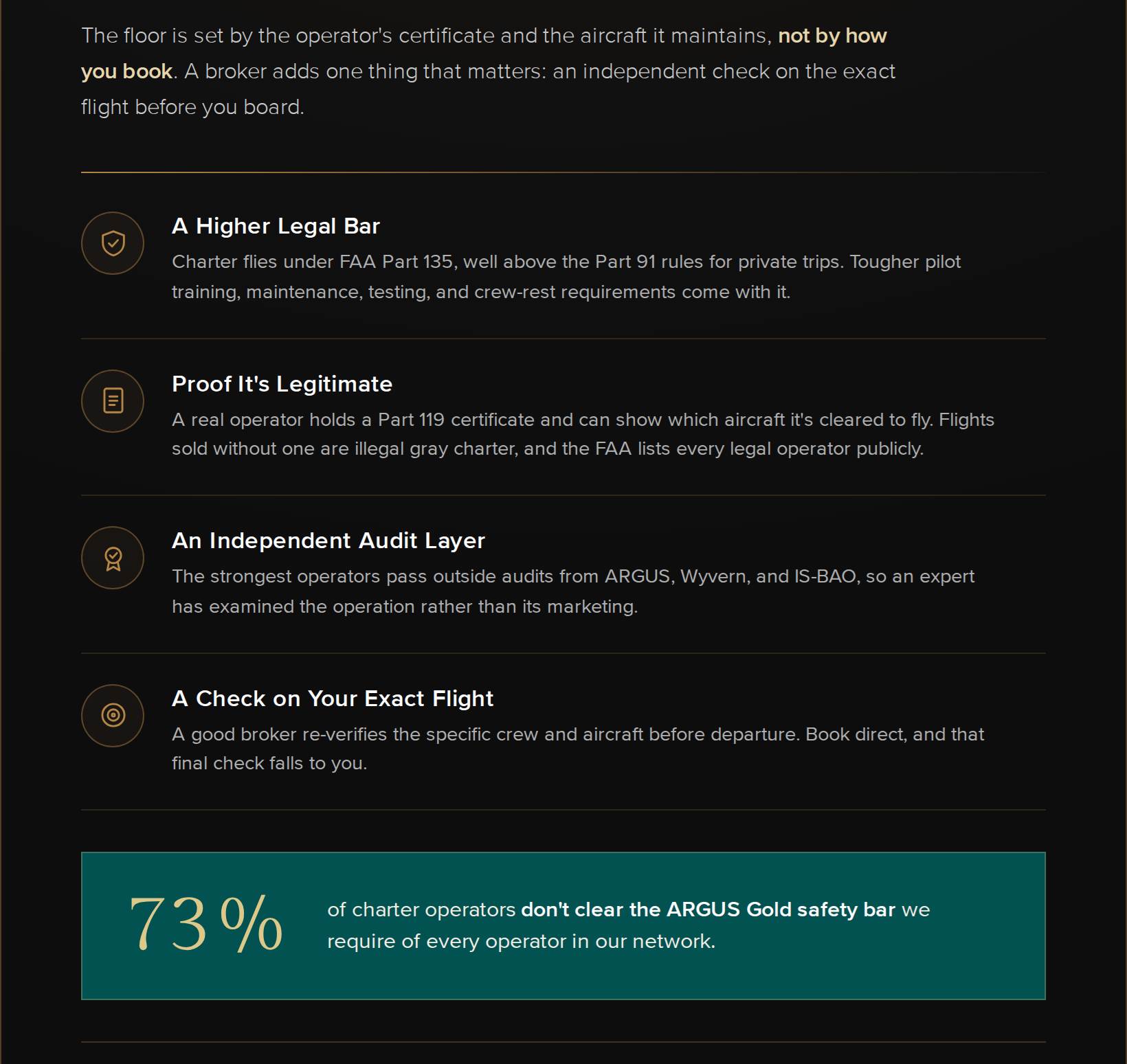
The safety standards you should expect ride on the operator, not on who books the flight. A Part 135 certificate and a well-kept aircraft set the floor, so a brokered trip and a direct one begin from the same place. What separates them is who runs the pre-flight check on the actual jet and crew, and if it happens at all. Book direct, and it falls to you.
 https://drive.google.com/file/d/1LQiF-mlk65QaWKEzIPx_bMDI-H4C-v2q/view?usp=sharing
Part 135 is the FAA's rulebook for on-demand charter, and it demands far more than the Part 91 rules that cover private, non-commercial flying. An operator earns its certificate under Part 119, the rule for air carriers and commercial operators, and then answers to stricter pilot training, maintenance programs, drug and alcohol testing, and duty-time limits a private flight never carries. Any trip sold for hire belongs under Part 135, and a legitimate operator can show you its certificate and the list of aircraft it's authorized to fly commercially.
Illegal "gray charter," meaning Part 91 flights sold for money without a Part 135 certificate, is common enough that the FAA built its searchable operator list to expose it and now pursues unlicensed operators through active enforcement.
The best operators build above that floor with voluntary audits the industry treats as table stakes. ARGUS rates operators Gold, Platinum, or Platinum Elite on safety history and operational record, Wyvern runs continuous real-time checks, and IS-BAO applies a global code of practice modeled on ICAO standards. A rating from any of them means an outside auditor has examined the operation, the layer of private jet travel safety most passengers never think to check.
Our own vetting runs on the same private jet safety protocols before every departure, not once at onboarding. Every operator has to clear an ARGUS Gold minimum that roughly 73% of charter operators don't meet, and ahead of each trip we run an ARGUS TripCHEQ or Wyvern PASS on the exact crew, aircraft, and operator, reviewed by our in-house safety manager. A yellow or red flag, say a second-in-command short on time in type, gets the crew changed before departure, and you can see exactly how we vet each operator and aircraft on our safety program.

Questions to Ask a Broker or Operator to Ensure Safety
The right questions separate a real answer about private jet safety from a smooth one, and the strongest are those you can verify yourself afterward, on a broker call or a direct one.
Can you confirm the operator holds a current Part 135 certificate, and is it listed on the FAA's public Part 135 operator database? Anyone can search that list by operator name or tail number, so the answer takes two minutes to verify.
Is this exact aircraft on the operator's FAA aircraft listing, the operations spec known as its D085, or only pictured on a website? A real operator can show the tail is authorized on its certificate and can produce that page on request.
Before I pay, will I get a pre-flight safety report, an ARGUS TripCHEQ or a Wyvern PASS, on the actual crew and aircraft flying me? A vague reply here is itself the answer.
Who holds operational control of this flight? The name you want to hear is the operator's, every single time.
What insurance is carried, and to what liability limits?
If the jet goes technical or weather closes the airport, what's the recovery plan, and what money comes back to me?
Coming from a broker, one more matters. Will you put your role, any relationship you have with the operator, and the full cost of the trip in writing?
Experienced jet charter clients ask these as a matter of course, and any operator or broker worth flying answers them without friction.
Private Jet Charter Contract Red Flags
A charter contract earns your trust by what it discloses, and DOT Part 295 already sets the minimum. A compliant broker has to tell you the capacity it's acting in, reveal any business relationship with the operator that will control the flight, state the total cost including third-party fees, and refund what you've paid when a trip can't be performed, within 20 days of a complete request. Read a contract against that standard, and the warning signs get easy to spot, since most of them are that rule turned upside down.
No named operator, or a dodge on who controls the flight. You're entitled to know which certificated carrier is flying you, and a broker that won't say is hiding either carelessness or a problem.
A role and a fee that never make it onto paper. The rule requires disclosure of how the broker is acting and what the trip costs all in, so a quote that stays deliberately fuzzy on both is a decision the broker made on purpose.
Charges that arrive vague, "estimated," or weeks after the flight, a fuel surcharge billed weeks after the fact for a few hundred dollars points to either a disorganized operation or a headline price engineered to look cheap. Honest jet charter pricing gets quoted in full before you fly, and it doesn't keep growing in the rearview mirror.
Nobody offers to verify the aircraft and crew before you pay. When no pre-flight safety report is on the table, the verification you're counting on probably isn't happening at all.
"We'll credit you" where you asked for a refund. Holding your money as future credit after an operator-caused failure, and refusing to return it, can signal cash-flow strain, and Part 295 gives you refund rights the operator's problems don't erase.
Pressure to decide now and wire fast. Real charter runs on availability and paperwork, not on urgency manufactured to keep you from reading the agreement.
Cancellation and substitution terms that live only in conversation. A promise about what happens if the aircraft changes means nothing until it's written into the contract.
What Brokers Demand From Operators
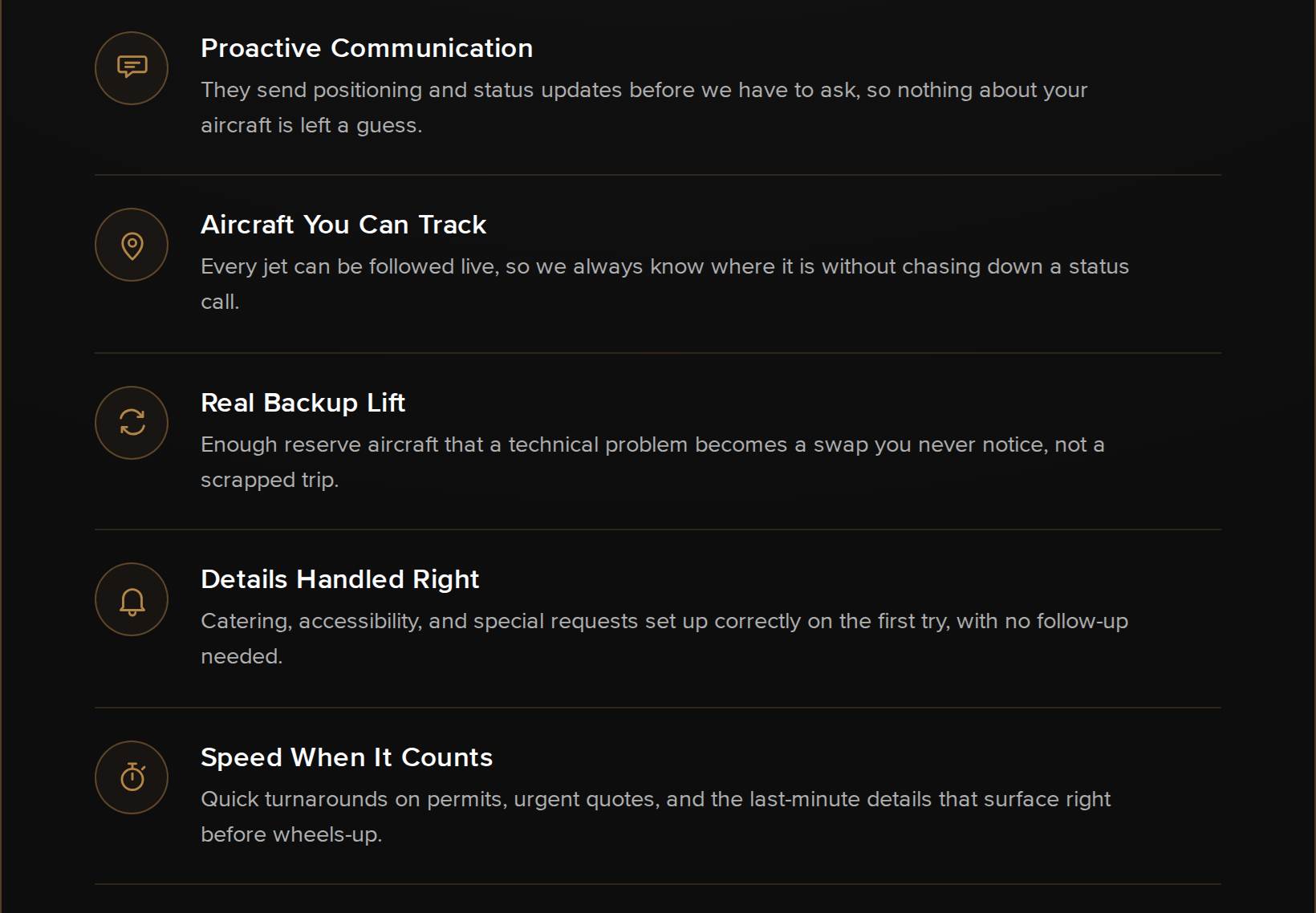
Everything above is why our network stays deliberately small, and the traits we insist on from an operator are the ones protecting your trip even when you never hear about them. The operators that keep our business running behave like genuine partners. The best of them tell us where the aircraft is before we ask, keep their tails trackable so we're never relying on a single phone call for a position, and hold real backup lift so a mechanical turns into a quiet swap and never reaches you as a cancellation. They handle the particular requests that make a trip feel personal, a specific catering order, wheelchair access arranged the first time correctly, without needing to be chased. And they move fast when it counts, on permits, on urgent quotes, on the pile of small questions that stack up in the hours before departure.
What Ends a Broker and Operator Relationship
The behaviors that get an operator dropped are mostly ones you'd never witness from your seat, and that gap is the strongest argument for a broker who sees them on your behalf. We walk away from operators whose crews behave badly in the cabin or on the radio, and from anyone who argues about signing a safety report or grumbles at the cost of running an ARGUS or Wyvern check. A run of mechanical failures and downtime, especially on aircraft that ought to be reliable, tells us the maintenance culture isn't what the paperwork claims. Going silent over a weekend or overnight, with a trip actively in the air, is disqualifying on its own. So is dressing up a listing with photos of a nicer aircraft than the one that turns up, since a client misled about the cabin has been misled about everything else.
Fly With a Broker That Vets on Your Behalf
Booking through a broker who works only for you gets you the same certificated operators the whole market flies, plus an independent set of eyes on every flight and one advocate who answers when plans change. Most jet charter clients want exactly that and rarely get it booking direct. Our pricing comes from operators bidding against each other for your trip, with the all-in number and its breakdown on the table before you commit, and the same transparency runs through our Jet Card, where the operator's cost and our margin sit in plain view on every quote. Before each departure, that pre-flight verification arrives in writing, and your refund rights travel with you under the rules that govern brokers. Seen from the client's seat, that is what dependable private jet safety looks like in practice.
Tell us where you need to be, and we'll quote it honestly. Start with a charter quote, or read exactly how we hold every operator to the standard before we ever put you on their aircraft.
About the Author
Richard Zaher founded Paramount Business Jets in 2005 and serves as its CEO, having set out to build a brokerage that answered only to the client. A pilot and a graduate of Embry-Riddle Aeronautical University, he earned a degree in aerospace studies with minors in flight safety and psychology, and the university later recognized him with its Eagle Excellence Award at the 2012 NBAA convention. As president of the Air Charter Association of North America, he worked with the US Department of Transportation on Part 295, the rule that set transparency and disclosure standards for charter brokers nationwide. His writing for the Paramount blog stays close to the decisions clients actually face when they charter a private jet, from safety vetting to contracts and cost.
FAQ
What Is the Difference Between a Private Jet Broker and an Operator?
The operator holds the FAA Part 135 certificate, keeps operational control, and actually flies you. A broker is your agent under DOT Part 295 and operates nothing. That registration covers disclosure and conduct, not airworthiness, so only the operator's certificate speaks to how safely you're flown.
Private Jet Operator vs Broker, Which Offers Better Safety Standards?
Both start from the same safety floor, set by the operator's certificate and the aircraft, not the booking channel. The practical risk is a legitimate operator putting a tail or crew member on your trip that isn't current or authorized that day, and a per-flight check catches it. Book direct and that check is yours to run.
What Questions Should I Ask a Private Jet Broker to Ensure Safety?
The most useful question is if they'll give you the pre-flight safety report, on your actual tail and crew, before you pay. Then confirm current Part 135 certification on the FAA's public list, and get a straight answer on who holds operational control. The best questions are the ones you can verify yourself.
What Are the Red Flags in a Private Jet Charter Contract?
The sharpest signal is a broker that won't put its role, its fee, and the operating carrier in writing, all three of which Part 295 requires, making a refusal a reportable DOT violation. Watch too for vague or after-the-fact fees and a credit-only answer when the operator caused the failure.
Do Brokers Have Their Own Fleet, or Source Aircraft From Third-Party Operators?
They source from certificated third-party operators, since brokers own no aircraft. Independence varies, though. Some platforms marketed as brokers are owned by an operator group, which pulls them toward a parent fleet, so ask any broker point-blank if it or its parent operates aircraft.