

Can You Smoke on Private Jets? A History of Smoking on Planes
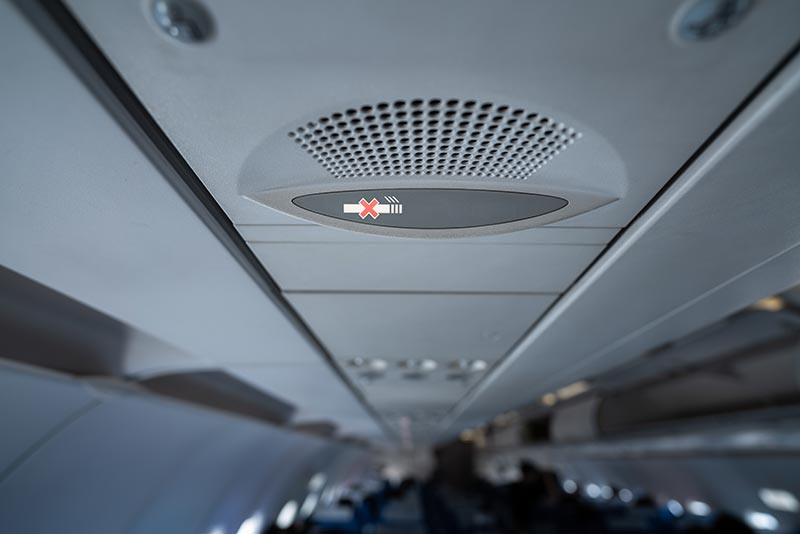
- Smoking is banned on all commercial flights worldwide, including cigarettes, cigars, and e-cigarettes.
- Some private jets may allow smoking, but only with prior approval from the operator or aircraft owner.
- Smoking bans began in the 1980s and became law in the U.S. for all commercial flights by 2000.
- The primary reasons for the ban were health concerns and the fire hazards associated with smoking in flight.
- Marijuana and THC products are strictly prohibited on both commercial and private aircraft under federal law.
- FAA fines for smoking or tampering with smoke detectors can reach up to $4,000—even on private flights.
Smoking cigarettes is always illegal on commercial flights, but it is sometimes allowed on private flights. On the other hand, smoking marijuana or other substances is always illegal on both commercial and private planes.
It wasn’t always the case that smoking was banned on planes, though. As you may remember, smoking used to be allowed on both commercial and private flights.
Curious to learn more about the current restrictions governing smoking on private jets? Wondering about the history of smoking on planes or when smoking was banned on commercial flights?
In this post, we’ll explore the history and status of smoking both tobacco and other substances on both private and commercial flights. We’ll aim to answer all your frequently asked questions about the topic.
Lighting Up In-Air: The History of Smoking on Airplanes
In the early days of air travel, many carriers forbade smoking, according to Smithsonian Magazine. Why? It wasn’t due to health concerns, but rather, flammability concerns.
During a time when planes were made from materials like wood, canvas, and rope, smoking posed a grave risk to passengers’ immediate safety. It wasn’t until the 1930s when airplanes were constructed of metal and had enclosed cabins that these rules changed.
From the 1930s through the 1970s, smoking in-flight was allowed or even encouraged, with some airlines providing complimentary cigarettes or cigars to customers. In fact, in the early days of air travel, when planes had windows that opened, passengers even sometimes tossed lit cigarettes out of open windows!
When Did Smoking Stop on Planes?
- In 1964, a now-famous U.S. Surgeon General’s report concluded that “smoking was a cause of lung cancer and chronic bronchitis and a probable cause of coronary heart disease”. This report turned the tide for smoking in the skies.
- In 1969, Ralph Nader formally petitioned for a ban on in-flight smoking.
- By 1988, smoking was banned on U.S. flights under two hours.
- By February 25, 1990, President George H.W. Bush signed legislation banning smoking on all domestic flights under six hours. Pilots, however, were still allowed to smoke due to concerns over nicotine withdrawal.
- The Wendell H. Ford Aviation Investment and Reform Act of 2000 banned smoking on all U.S. commercial flights and international legs. But even then, it would take some time for all countries across the globe to ban smoking on commercial planes.
- The EU enacted a ban in 1997.
- Countries such as Cuba and China continued to allow smoking until 2014 and 2017, respectively.
Smoking on Airplanes Today
China was the last country to ban smoking on commercial flights. As of now, you cannot legally smoke or vape anything on any commercial flight in any country or on any airline. And fines for smoking on planes are high. In the U.S., we’ve seen fines as high as around $4,000, with vaping fines around $2,000.
But generally speaking, you are legally allowed to smoke on a private jet charter. Whether or not you are allowed to smoke on a private plane in practice – even if technically allowed by law – is governed by the rules set forth by the operator of the plane.
What Rules Govern Smoking on Private Jets?
Whether you can or cannot smoke on a private jet charter depends entirely on the operator or aircraft owner’s rules. Generally, the pilot of a private aircraft can also determine whether or not you are allowed to smoke in flight.
If you own your private jet, then of course you are free to smoke on it! However, if you charter a private jet, that’s where things become trickier. That’s why, if you are a smoker who wants to smoke onboard your next charter flight, it’s generally a good idea to work with a third-party charter company to try and help you find an operator that meets your needs rather than trying to seek out an operator that allows smoking on your own.
Most operators do not allow smoking, and those that do usually require approval in advance.
You should also be aware that in instances where smoking is allowed, passengers often remain liable for any damage to the aircraft or fire risks. The FAA also imposes fines for tampering with safety equipment on both commercial and private aircraft.
For these reasons, many smokers prefer to minimize risk by using nicotine gum or patches during flights.
Other FAQs About Smoking on Planes
When Was Smoking Banned on Planes Commercially?
In the U.S., smoking was banned on all domestic flights under six hours in 1990. Smoking on all U.S. commercial flights and international legs was banned ten years later in 2000.
Do Any Flights Still Allow Smoking?
No. All scheduled commercial flights globally prohibit smoking, and that includes the use of e-cigarettes. Some private jet operators may allow smoking; however, permission is usually provided on a case-by-case basis with prior approval.
Can You Smoke Marijuana on Planes?
No. You also cannot consume cannabis (“edibles”) because although it cannabis is legal in some U.S. states, at airports and in federal airspace, federal law applies, and according to federal law, bringing THC on aircraft or using THC/cannabis products is illegal.
Can You Smoke Cigars or Pipes on Planes?
Not on commercial planes. You may be able to smoke cigars or pipes on chartered flights with prior permission.
Why Was Smoking Banned on Commercial Planes?
Smoking on planes was primarily banned due to health concerns surrounding secondhand smoke, along with fire risk. Flight attendants and non-smoking passengers often suffered from serious health issues, and fatal accidents were linked to in-flight fires caused by smoking.
When Did Smoking Become Illegal on International Flights?
By the early 2000s, most international airlines had implemented smoking bans. China was the last country to ban smoking from both cockpits and cabins in 2017.
Get Help Finding a Smoking-Friendly Charter Flight
While the golden age of smoking in the skies is long gone, understanding the rules around smoking on aircraft can help you avoid costly fines both when flying commercially and privately.
If you’re a smoker who’s looking to fly private and smoke in-flight, you may find it challenging to find an operator who will accommodate you, but if you work with a charter company like Paramount Business Jets, we will do everything we can to match you with an operator that will accommodate you.
At Paramount Business Jets, we work with you to ensure every detail of your flight is tailored to your preferences. Get in touch today for help securing a smoking-friendly charter flight.