

While many assume that private aviation is inherently well-regulated and vetted, the truth is a lot more nuanced. What separates a genuinely safety-conscious charter operator from others in the industry is a layered system of standards, audits, and pre-flight checks that most travelers never see. Paramount Business Jets has pulled data from leading sources, including the Federal Aviation Administration, Cornell University, ARGUS International, Wyvern, and more, to provide a peek behind the curtain of private jet safety standards.
The regulatory floor: What FAA Part 135 actually requires
In the U.S., any company operating charter flights for hire falls under Title 14 of the Code of Federal Regulations, Part 135, per the FAA. Commonly called “Part 135” for short, it is a certification only awarded once an operator shows the FAA that they have the infrastructure, personnel, maintenance programs, and operational manuals required to run safe charters. Acquiring this certification requires extensive documentation, inspections, and ride checks before any paying passenger is allowed onboard.
Once an operator receives certification, they are bound by ongoing requirements that govern basically every aspect of flight. Pilots must hold an airline transport pilot certificate to serve as the pilot in command. This requires at least 1,200 hours of total flight time with specific minimums for instrument, night, and cross-country hours depending on the type of operator, requirements outlined in depth by Cornell Law School. Any recurring training and proficiency checks must also be adhered to on a fixed schedule.
Part 135 operators must also follow an FAA-approved inspection program. Keeping meticulous aircraft records and ensuring aircraft are always worthy to depart are a part of this rigorous program. Should any unscheduled maintenance findings be discovered, they must also be addressed and documented. Essentially, nothing flies with a known defect that hasn’t been properly resolved or deferred.
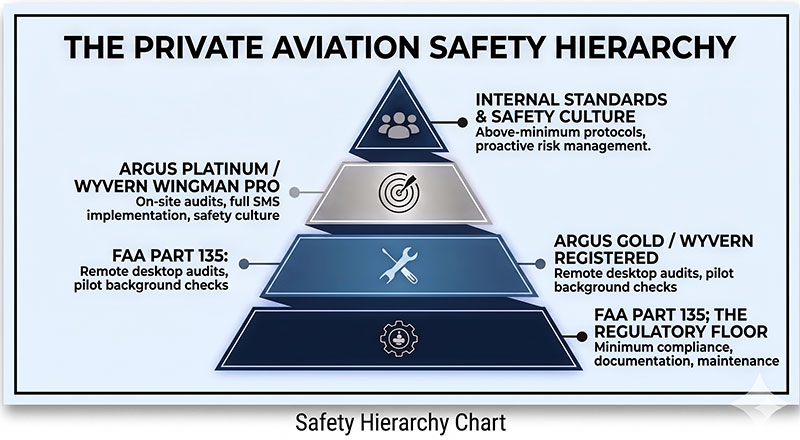
Part 135 certification matters, but it’s just the minimum when it comes to safety. This certification defines what is legally required to operate, but the best brokers ensure their operators strive for more.
Third-party rating systems: Raising the bar above the regulatory floor
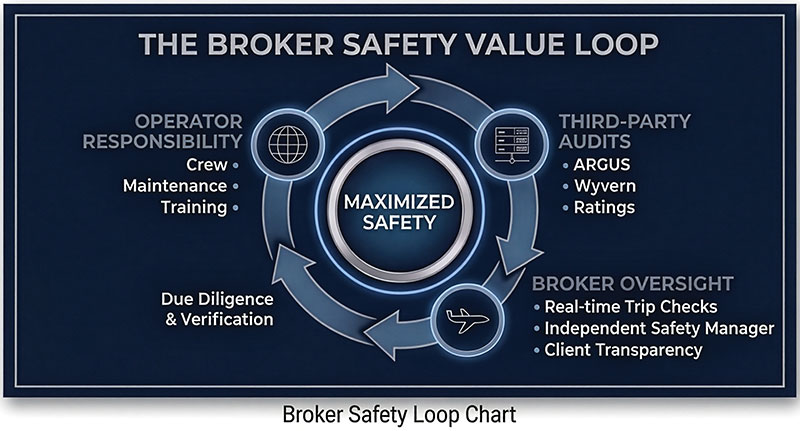
To help travelers and brokers alike identify operators who go beyond minimum compliance, two independent organizations, ARGUS International and Wyvern, have developed their own safety ratings systems. Earning a rating from either organization in addition to Part 135 certification is entirely voluntary, but that’s precisely what makes them so meaningful.
ARGUS International
First, ARGUS International offers two main tiers for ratings: Gold and Platinum. At the Gold level, operators take part in a remote desktop audit that validates their FAA compliance, confirms pilot background checks are in place, reviews safety records, and verifies the existence of an emergency response plan. It’s a thorough examination, but it happens at a distance, handled through submitted documentation as opposed to boots on the ground.
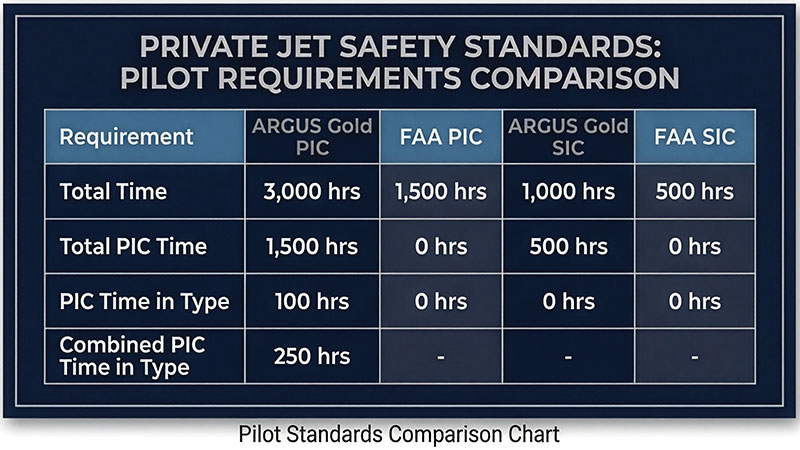
For added perspective on the differences between ARGUS Gold minimums and how they compare to FAA standards, below is a chart outlining time requirements at both the pilot-in-command and second-in-command levels:
In contrast to Gold, ARGUS Platinum is designed for the truly safety-minded. Platinum-rated operators must undergo a two-day, on-site audit conducted by ARGUS personnel. These individuals inspect the operational services of the companies, including everything from maintenance records, staff interviews, evaluating safety management systems, and assessing culture. Recertification is annual, and there are also semi-annual reviews in between.
In late 2025, ARGUS announced impending updates to its Gold standard, which will require several additional safety measures. The best practice for brokers is to require all operators to maintain a minimum standard of ARGUS Gold.
Wyvern
Wyvern operates a parallel framework to ARGUS International. At the Registered level, operators must submit documentation confirming regulatory compliance and participation in Wyvern’s ACES system. This system tracks pilot recurrence and training records. Wyvern Wingman, the middle tier, requires a two-day, on-site audit similar to ARGUS’s Platinum level that evaluates safety management practices. Recertification happens every two years.
The highest designation Wyvern offers is the Wingman PRO option. Operators at this level must commit to ongoing quarterly oversight, full safety management system implementation, which includes human factors training, and continuous monitoring.
A certificate from either ARGUS International or Wyvern is still only a small portion of the safety story. The other part happens before every single flight takes off.
What a comprehensive pre-flight safety check actually looks like
For any charter traveler, the flight begins at the terminal. For the crew, however, it began hours earlier or even the night before.
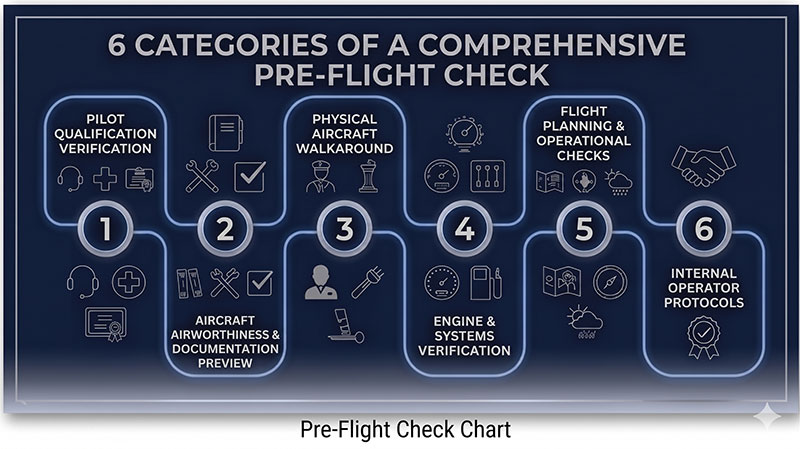
A comprehensive pre-flight safety checklist isn’t just a single event. It’s a sequence of overlapping verifications that start with the people in the cockpit and travels all the way down to the aircraft itself. Every operator is different, but Superior Flight School outlines a number of crucial steps. Here are the standard six pre-flight safety checklist categories all operators should have in place:
Pilot qualification verification: Before a pilot ever steps onto an aircraft, a responsible operator has already taken steps to confirm they are current and qualified for that flight. This entails checking their medical certification, instrument currency, and recurrent training are all up to date. The best operators go further by setting internal minimums for total flight hours and recent activity that exceed FAA demands.
Aircraft airworthiness and documentation review: The aircraft itself should always be reviewed on paper before anyone looks at it physically. The crew should check airworthiness directives to confirm the aircraft is in compliance, review the aircraft’s maintenance logs, and confirm the minimum equipment list has been applied.
Physical aircraft walkaround: The walkaround is exactly what the name implies. Pilots will move systematically around the aircraft, checking flight control surfaces for damage or unusual movement. They will also inspect the tires for wear and proper inflation, look for fluid leaks, verify tubes and ports are unobstructed, and check that all lights, antennas, and panels are intact.
Engine and systems verification: In the cockpit, the crew will work through manufacturer-specified checklists that verify avionics, navigation systems, hydraulics pressurization, environmental controls, and more. The aim is to ensure everything is functioning properly. Fuel quantity and quality will also be confirmed. Engine start procedures will be followed precisely and post-start indications will be reviewed before any movement towards the runway has occurred. Every single system will be scrutinized closely during this stage.
Flight planning and operational checks: Parallel to the aircraft checks, the crew will also review the full flight plan. This includes the route, alternative airports, fuel reserves, notices to air missions for the destination and en route airports, and weather briefings. Weight and balance calculations will also confirm that the aircraft is loaded properly. If the route is longer or more complex, operators may also perform a threat and error management briefing to inform the crew how they should respond if something goes awry.
Internal operator protocols beyond the rating tier: Finally, this last step is where the gap between operators becomes the most visible. An operator who has already achieved ARGUS Gold, for instance, has met a meaningful benchmark. But many will go a step further and integrate internal standards that surpass what Gold requires.
All of these protocols are not advertised on a rating certificate. However, they exist because safety culture at the best operators is not about satisfying an auditor, but rather keeping you safe in the air.
On top of this checklist from the operator side, premium brokers also require additional safety checks such as Trip Check from ARGUS or Pass Report by Wyvern, which essentially verifies that the operator has met all of the above criteria to maximize safety in air. This is on top of due diligence collection, such as notes from the trip or other information from past routes the operator has run, to ensure that the client experience is enjoyable and reliability is certain.
The broker difference
Partnering with a broker who can source operators for your needs adds another layer of security to the above certifications. Safety-conscious brokers will often run real-time third party safety checks, prior to your departure and provide clients with the report. In instances where this report comes back as yellow or red, perhaps due to a second in command not having enough time in type, for instance, the operator will be asked to replace them with more experienced crew.
Safety checks are run days prior to your journey, with the crew being greenlit upon assignment. By the time your trip has come around, operator paperwork has been stamped to ensure they have met or exceed ARGUS Gold standards. Brokers will also employ an in-house safety manager to ensure a safe and comfortable trip.
In the event you don’t choose to partner with a broker, you can still request your operator to run the ARGUS Trip Check and provide you with the report for peace of mind. Most operators won’t do this unless requested, so you’ll need to remember to ask.
Questions every private jet traveler should ask before booking
Ratings are a useful signal, but they aren’t a substitute for asking direct questions yourself. A reputable broker or operator should always be willing to answer your questions. Here is just a sample you can consider bringing up ahead of booking your next flight:
What ARGUS or Wyvern rating do you hold and when was it last certified?
What are your internal pilot minimums for total time, time in type, and recent flight experience?
Do you provide a third party safety check report prior to the flight?
Do you carry liability insurance and at what coverage level?
How do you handle a maintenance finding that comes up during the pre-flight check?
An operator who provides boilerplate answers or simply says “whatever the FAA requires of us" may not be operating at the highest standard. Additionally, answers to each of these questions reveal crucial facts, such as whether the operator is functioning above baseline standards or whether the operator has protocols in place to respond to safety concerns.
If a broker is sourcing an aircraft on your behalf rather than operating it directly, you should also present these questions to that broker once they let you know their selection. The best brokers will know the answers to these questions.
Safety is a spectrum, not a switch
The private aviation industry is not necessarily a monolith of safety. At one end of the spectrum, you will find operators who hold a Part 135 certificate only. They meet the FAA’s baseline safety requirements and do little more.
At the other end, you will find operators who are pursuing the highest degree of voluntary ratings in addition to Part 135 certification. These are the operators who set internal standards above those ratings and build a culture where every pre-flight checklist is treated with the same weight regardless of whether the passenger is a regular or a new client.
Most travelers will never see the behind-the-scenes documentation review, walkarounds of a plane, weight and balance calculations, or crew briefings. Nor should they. A well-run operation should feel seamless and ensure that you aren’t wondering whether the plane you are about to step on is safe or not. By allowing your broker to objectively vet the market on your behalf, you can have peace of mind that all due diligence requirements and safety checks have been met.
Asking the right questions before booking your ticket isn’t about distrust. Rather, it’s about understanding that, in private aviation, there is a significant gap between the bare minimum and the very best. By figuring out where your chosen operator falls on that spectrum, you can feel safer in the air.