

Travel by private jet hit a record in 2025. Why luxury in the sky isn’t just for the wealthy anymore
What makes this milestone particularly remarkable isn’t just the volume. It’s who’s flying and why. Once seen as an exclusive commodity enjoyed only by billionaires and executives, private aviation is rapidly evolving into a flexible and experience-driven alternative, one that is increasingly being adopted by younger travelers and professionals seeking to seamlessly blend work with leisure.
Paramount Business Jets has analyzed data from WINGX, Mordor Intelligence, Forbes, Airvoir, and other sources to demonstrate how 2025’s record year marked a significant shift in how people prioritize time, mobility, and control in the post-pandemic travel economy. We’ll also break down what to expect in 2026.
By the numbers: A record year for private aviation
Industry data compiled by WINGX, the aviation industry data intelligence service, reveals a compelling story in recent private jet travel:
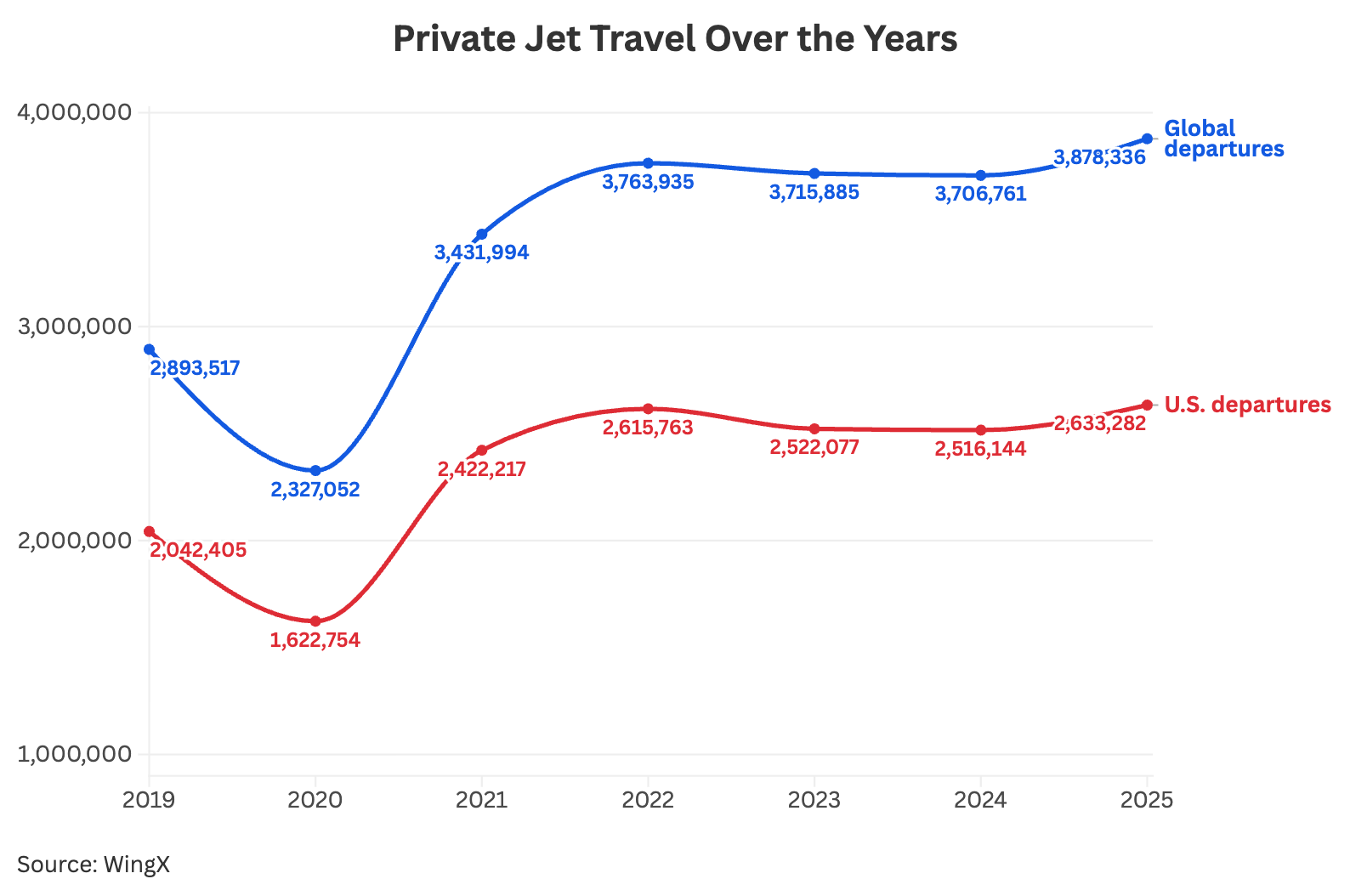
2025 is clearly the largest year on record for both global departures and U.S. departures, following a relatively stable period from 2022 to 2024 after the recovery of the industry post-pandemic. As a whole, the North American market remains the largest share, while Europe and the Middle East have seen fast growth rates.
Market analysis from the privately held market intelligence and advisory firm Mordor Intelligence predicts the growth won’t slow down. In fact, the industry is expected to grow from around $16.38 billion to nearly $17.67 billion in 2026. This trajectory reflects rising use rather than just higher prices, meaning more people are flying private and they’re doing it more often.
The new private jet traveler: Younger, more diverse, and driven by flexibility
Perhaps the most striking change driving the record numbers is the demographic shift of private jet travelers. Private aviation is no longer dominated by the stereotypical older business executive. Industry surveys and booking data show the private jet customer base is rapidly diversifying.
Data from Market Growth Reports reveals that the number of first-time private flyers increased by 21% from 2022-2024. This seemingly signals that the barriers to entry for private jet travel are falling. Charter platforms, jet cards, and on-demand booking apps have made private flying feel less opaque and more accessible than ever, especially for younger professionals.
Jetcraft, a leading airline broker, outlined that the share of Jetcraft purchasers under 45 nearly doubled in the last decade. Of their purchasers, roughly 42% come from the entertainment industry now, and 29% of those are women, representing a new market. As jets continue to be seen less as status symbols and more as productivity tools to compress time and avoid missed connections, this diversification is only expected to continue.
The rise of "Bleisure" and changing travel patterns
Another important behavioral shift has been the rise of “Bleisure” travel. These are trips that combine business and leisure into a single itinerary. Market Growth Reports also noted that an estimated 27% of private charter bookings are attributed to hybrid business-leisure travel, up from 19% in 2022. Unlike traditional corporate travel, bleisure trips often involve:
Longer stays at destinations
Flexible return dates
Family members or partners joining the trip
Routes that connect business hubs with resorts or secondary leisure locations
Private jets are uniquely suited to this hybrid model, as travelers can attend meetings in one city and quickly fly directly to vacation destinations without layovers or crowded terminals. As remote and hybrid work continue to become the norm, the line between being “on” and “off” at work will continue to blur. Data from Forbes indicating month-over-month increases in air travel notes that this shift is not cyclical. Rather, it reflects a redefinition of how high-income professionals structure work itself.
Looking ahead: What’s in store for 2026 for private aviation
Early indicators suggest that 2026 will build on 2025’s momentum. Preliminary January data already show continued year-over-year growth in private jet activity, even as broader economic uncertainty persists.
Forecasts from market research firms anticipate continued expansion in charter and jet card programs, strong demand for light and midsize jets serving regional routes, and increased competition among booking platforms. While growth rates may moderate slightly, the consensus view seems clear: Private aviation has structurally reset to a higher baseline than pre-2020 norms.
Given that the record-setting year for private jet travel in 2025 wasn’t driven solely by the ultra-wealthy flying more, but rather by a changing traveler profile and evolving travel priorities, there’s no indication that the industry will falter. Younger professionals, first-time flyers, and bleisure travelers are reshaping private aviation from a niche luxury into a flexible, productivity-focused mode of transport.
With flight volumes at an all-time high and market growth projected to continue into 2026, private aviation’s transformation appears durable. What was once nearly unattainable for the average person is becoming increasingly normalized, and this shift may prove to be the industry’s most powerful tailwind of all time.